
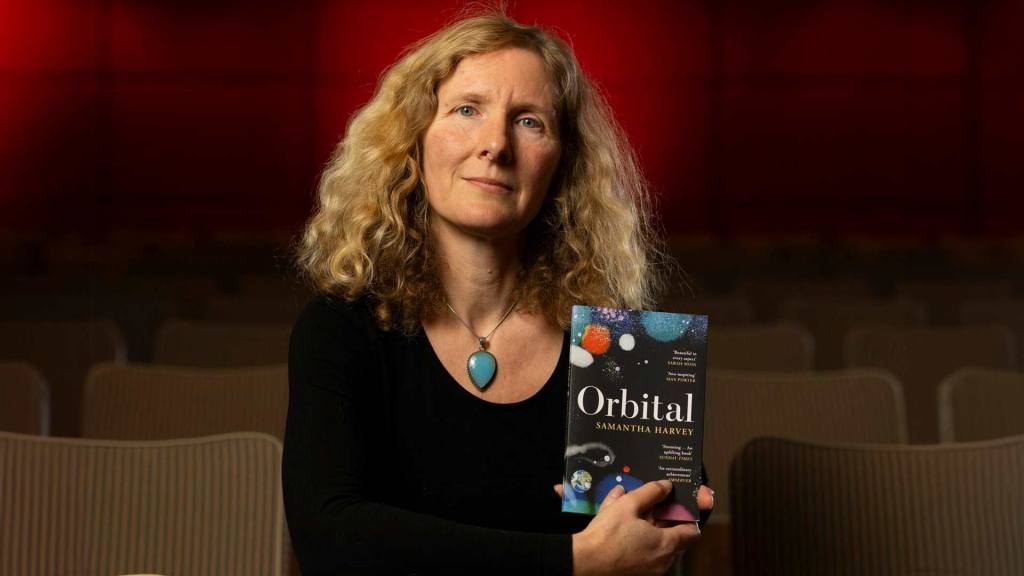
As writers, we continually seek inspiration, new techniques, and fresh perspectives to push the boundaries of our craft. Every so often, a novel emerges that challenges our preconceptions about storytelling, structure, and genre. Samantha Harvey’s Orbital, the groundbreaking 2024 Booker Prize winner, is precisely such a book. Hailed as “slim, powerful, and uplifting,” and often described as “more akin to poetry than prose,” Orbital offers a masterclass not just in profound meditation but in innovative literary construction.
This isn’t a typical science fiction adventure. Harvey herself states she’s “not a sci-fi writer” but a “realist,” aiming to depict “ordinary life up there” in an “extraordinary setting.” This intentional blurring of genre boundaries, combined with its profound critical and commercial success—including being a New York Times and Stephen Colbert Book Club Pick, and one of Barack Obama’s Favourite Books of 2024—makes Orbital an invaluable case study for any writer looking to innovate.
What can we learn from a novel set aboard a space station that feels more like a prose poem than a conventional narrative?
Redefining Genre Through Rigorous Realism
One of Orbital‘s most striking lessons is its audacious redefinition of genre. While set on a space station, it consciously eschews speculative fantasy for meticulous scientific realism. Harvey’s extensive research into astronaut routines, space physiology, and ISS protocols—down to details like vacuuming and meal planning—grounds the narrative in verifiable truth. This isn’t about futuristic technology or alien encounters; it’s about the documented, often mundane, realities of life in low-Earth orbit.
For writers, this is a powerful reminder that “science fiction” doesn’t always have to mean inventing new worlds or fantastical elements. It can, instead, refer to a deeply researched exploration of actual scientific principles and their human implications. By anchoring her extraordinary setting in documented truth, Harvey elevates the “science” in “science fiction” to a level of profound literary and philosophical inquiry. This approach, validated by the Booker Prize, suggests a rich pathway for works that blend scientific precision with deep human introspection. Consider how you might use real-world facts, even from seemingly dry subjects, to build the foundation for a deeply immersive and thought-provoking story. How can realism open up new avenues for “speculation” on the human condition?
The Power of the Plotless Narrative: When Atmosphere Trumps Action
Perhaps the most discussed aspect of Orbital is its deliberate lack of a traditional plot. Reviewers consistently call it “plotless,” a “mood-piece,” or a “meditation” rather than a story driven by intricate storylines or twists. The narrative unfolds over a single 24-hour period, mirroring the 16 orbits the space station completes around Earth, with each orbit often correlating to a chapter.
Harvey isn’t interested in what happens next in a conventional sense, but in what is. She meticulously details official duties and daily routines, but primarily focuses on the astronauts’ profound internal reflections. The minor incidents—the death of Chie’s mother, the gathering typhoon—serve less as plot points and more as catalysts for internal contemplation.
For writers wrestling with narrative structure, Orbital dares us to ask: What if my story isn’t about external conflict, but internal transformation? What if the “events” are simply the passage of time and the shift in perspective? The book’s brevity (around 150-200 pages) is crucial here; it compels the reader to “experience the whole day alongside the astronauts,” creating an immersive, almost real-time connection. This challenges us to consider how form can dictate experience. Can a minimalist plot intensify philosophical engagement? Can repetition and subtle shifts in observation create a richer narrative than a complex sequence of events? Harvey demonstrates that a novel can be profoundly impactful by sustaining a mood and facilitating deep philosophical inquiry, even without a strong external plot.
Character as Collective: Blurring Distinctions for Universal Resonance
Another unconventional choice in Orbital is Harvey’s intentional blurring of individual character distinctions. While we meet six astronauts from diverse backgrounds (Japan, US, Britain, Italy, Russia), their individualities gradually dissolve, leading them to “almost seem to merge into one.” They are depicted as “different facets of a single person,” a “microcosm of humanity.” Harvey aims for “equivalence between people and things,” meaning the astronauts’ internal reflections are as much a part of the narrative’s “landscape” as the physical Earth below. For writers, this opens up fascinating possibilities. What if your characters are less about individual psychological drama and more about embodying a collective consciousness or universal human experience? How can de-emphasising personal arcs shift focus to broader themes?
By making her characters archetypal rather than deeply individual, Harvey invites readers to project their humanity onto them, fostering a universal connection to themes of existence, environmental responsibility, and interconnectedness. This supports the novel’s “God’s eye view,” where individual differences diminish, revealing a shared human experience. Consider how a collective protagonist, or characters whose distinctions blur, could serve your story’s larger thematic aims.
Thematic Depth as the True Narrative Arc
If Orbital lacks a traditional plot, its narrative propulsion comes entirely from its profound thematic depth. The novel is a meditation on humanity’s place in the universe, exploring existential questions of meaning, isolation, and interconnectedness. From their orbital perch, the astronauts gain “new clarity,” a perspective “uncorrupted from biases, tribalism, and conflict.” They transcend national borders, emphasising a shared humanity and the “futility of territorial conflicts.”
For writers, this is a powerful lesson: your themes can be the heart of your story. The astronauts grapple with the meaning of life, the existence of God, and the paradoxical “everythingness and nothingness of life.” Time itself becomes a central character, with the dizzying cycle of 16 sunrises and sunsets in 24 hours distorting their perception and compelling them to “re-learn how to negotiate their body clocks.”
Crucially, Orbital functions as a “love letter to the planet” and a “moving elegy to our environment.” Climate change is implicitly and explicitly woven throughout, symbolised by a gathering super-typhoon. The central question posed is profound: “why would we not want to protect something as beautiful and precious as Earth?” This book demonstrates that urgent, vital messages can be conveyed not through polemics, but through immersive experience and subtle, poetic observation. How can your themes provide the engine for your narrative, even without a conventional storyline?
Poeticising Scientific Realism: The Lyrical Power of Precision
Harvey’s prose is consistently lauded as “beautifully written” and “poetic,” often creating descriptions of Earth from orbit so vivid they transport the reader into the spacecraft. She balances “technical accuracy with lyrical elegance.” For example, the “pleating and folding of the Dolomites and Alps” or continents appearing to run “into each other like overgrown gardens.”
This “poeticization of scientific realism” is a hallmark of Harvey’s craft. She doesn’t just describe; she evokes. She transforms factual details into profound aesthetic and emotional insights. For writers, this is an invitation to elevate your descriptive language. How can you find the poetry in the seemingly mundane or technical? How can precise observation lead to transcendent imagery? Harvey’s success demonstrates that scientific rigour can enhance, rather than constrain, poetic expression, creating an immersive and profoundly moving experience that transcends genre expectations.
Unconventional Narrative Techniques: Breaking the Rules Deliberately
Orbital employs several non-traditional narrative techniques that contribute to its unique character. Notably, it largely eschews quotation marks for dialogue, causing conversations to blend seamlessly into the descriptive prose. This choice forces readers to pay closer attention, blurring the lines between external speech and internal thought, and avoiding jarring shifts in the novel’s meditative voice.
For writers, this is a powerful example of how deliberate stylistic choices can shape the reader’s experience. Are there rules of grammar or convention you could break to achieve a specific effect? The blurring of character voices, the constant shifts in perspective, and the third-person limited viewpoint – all serve to create a fluid, dreamlike haziness that reinforces the novel’s universalising themes. What narrative conventions might you challenge to deepen your reader’s engagement or achieve a unique aesthetic?
Lessons from Critical Acclaim (and Its Paradox)
The critical reception of Orbital offers another compelling lesson. Despite frequent observations that it “barely resembles a conventional novel” due to its minimal plot and sometimes underdeveloped characters, it won the Booker Prize. This paradox is telling. Critics lauded its capacity to “blur distinctions between borders, time zones and our individual stories” and its compelling case for “co-operation and respect for our shared humanity.” James Wood called it “the strangest and most magical of projects” that “performs the kind of task that only a novel could dare.”
This signals an evolving understanding within the literary establishment of what constitutes a “novel” and what is considered literary excellence. It suggests a growing appreciation for works that prioritise immersive experience, philosophical inquiry, and lyrical expression over conventional narrative propulsion. For any writer feeling constrained by traditional expectations, Orbital‘s success is a beacon of hope, demonstrating that profound thematic depth and exquisite prose can triumph over adherence to established plot structures.
Authorial Vision and Overcoming Self-Doubt
Finally, Harvey’s journey in writing Orbital offers deeply relatable insights for any creative. She initially abandoned the book after 5,000 words, overwhelmed by self-doubt: “‘Who am I to do this?’” She felt she was “trespassing in space” without firsthand experience. Yet, she recommenced, embracing the understanding that fiction is rooted in empathy and imagination, not solely direct experience. Her inspiration came from a “profound feeling” about Earth images from space, which she sought to translate into words, viewing the book as “much as a piece of music or a painting as I did a novel.”
This personal struggle mirrors the novel’s themes of human insignificance versus its critical importance. By overcoming her “trespassing,” Harvey embodies the very act of transcending individual limitations to grasp a universal perspective. Her disciplined, research-intensive process—treating writing “like a nine-to-five job” and believing “inspiration comes through the act of doing, not waiting”—is a practical lesson in perseverance.
Conclusion: Dare to Defy Gravity
Samantha Harvey’s Orbital is more than just a brilliant novel; it’s a manifesto for literary innovation. It challenges us to rethink plot, character, genre, and even the very purpose of a story. By balancing meticulous realism with poetic lyricism and by prioritising profound philosophical inquiry over traditional narrative arcs, Harvey has created a work that resonates deeply and widely.
For writers, the takeaway is clear: dare to defy gravity. Dare to explore new structures. Dare to let your themes drive your story. Dare to trust your imagination and empathy, even when writing about subjects outside your direct experience. And above all, dare to write with a conviction that your words, like the astronauts in Orbital, can offer a new, vital perspective on what it means to be human in this vast and wondrous universe.
 The Original Writers Group