
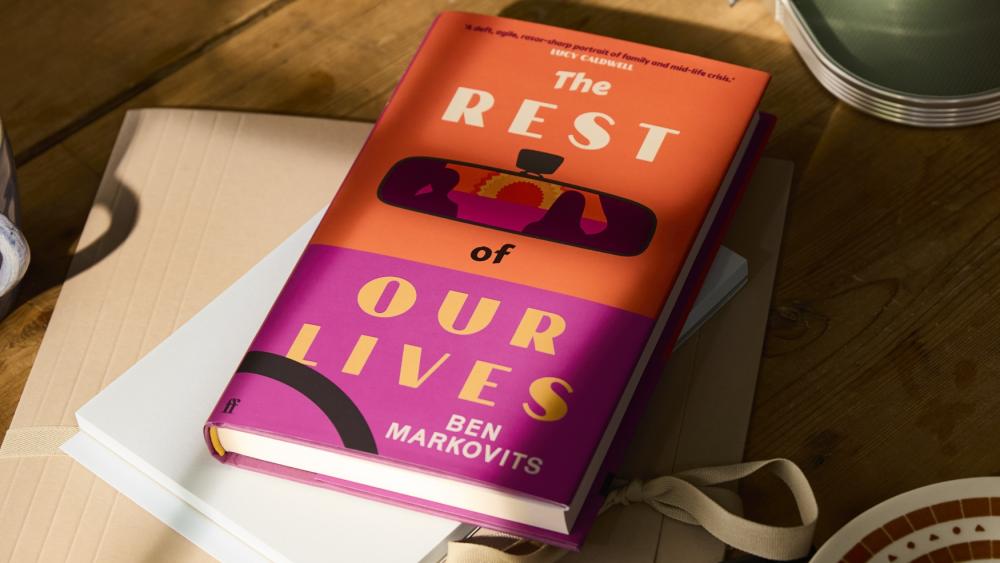
This is the fifth of six posts in which we examine the six writers shortlisted for the 2025 Booker Prize, with the winner to be announced on Monday, 10 November.
The Architecture of Quiet Confidence: Analysing the Craft of Ben Markovits
Ben Markovits’ twelfth novel, The Rest of Our Lives, shortlisted for the 2025 Booker Prize, celebrated not only a career milestone but also highlighted his accurate and disciplined writing style.
For writers committed to the craft, Markovits exemplifies how restraint, sincerity, and the skilful conversion of personal history can create deep social and psychological realism. His work is subtle and humble, reaching excellence not with showy displays but through careful precision. This technique guides the reader not to the facts of a plot, but to the edges of emotional truth.
Ben Markovits’s fiction is rooted in a unique blend of global experience, academic rigour, and unexpected professional exposure. His background plays a key role in developing the dual perspective — simultaneously intimate and detached — that characterises his social critique.
Born in California, Markovits experienced a diverse upbringing across Texas, London, and Berlin. This early contact with different cultures gave him a vital transatlantic sensibility, enabling him to see both American ambition and European restraint from an insider/outsider viewpoint. Through studies at Yale University, followed by postgraduate work at the University of Oxford, this blend of an American educational background and a strict European academic structure equipped him to critically analyse contemporary culture without jumping to easy conclusions. Today, he lives in London, where he teaches Creative Writing and Practice-based Research as a Professor in English at Royal Holloway, University of London, continually refining his analytical and teaching abilities.
Beyond academia, Markovits brought a distinctive professional background to his work. Before his current role, he worked as a high school English teacher and served as the editor of a left-wing culture magazine. Most unusually, he played professional basketball in Landshut, Germany, competing in the southern league of the German second division.
This period of disciplined, physical labour in a non-literary field was not merely a biographical footnote; it served as the foundational material for his 2010 novel, Playing Days. The willingness to turn personal experience, even something as physically specific as professional sports, into nuanced fiction shows a consistent belief that life, in all its forms, is valid subject matter. This blend of American education, the grit of professional sport, a European intellectual base, and an eventually acquired English sensibility positions Markovits perfectly to portray the emotional and cultural disillusionment of the contemporary global middle class.
The Evolving Architecture of Markovits’s Works
Markovits is a prolific novelist, with The Rest of Our Lives being his twelfth novel, and his bibliography is characterised by an elegant movement across genres, indicating an author committed to discovering the most suitable structural framework for his current thematic concerns.
An ambitious project marked his early career: the Byron Trilogy. This series established him as a master of literary history and metafiction, using biographical material to explore complex questions of identity, history, and narrative reliability. The trilogy began with Imposture (2007), which focused on John Polidori, Byron’s doctor. He followed this with A Quiet Adjustment (2008), which centred on the events leading to Annabella Milbanke becoming Lady Byron. The final volume, Childish Loves (2011), advanced cross-genre experimentation by featuring Byron as a narrator while blending biographical reconstruction with an alleged, possibly false, autobiography of Markovits.
This period of formal play extended to Playing Days (2010), a book advertised as a novel but that closely resembles a memoir, providing an accurate account of his brief professional basketball career. The key lesson for writers here is the power of cross-genre sincerity: Markovits demonstrated a willingness to breach the structural boundaries of fiction and memoir to achieve a deeper emotional or sociological truth. This trait would become characteristic of his later works.
In the mid-2010s, Markovits shifted markedly towards contemporary social critique, reaching a peak with his James Tait Black Prize-winning novel, You Don’t Have To Live Like This (2015). This work directly addresses the deep-rooted issues confronting the United States in the aftermath of the financial crisis. The protagonist, Greg Marnier, is a quintessential Markovits figure: an academic with degrees from Yale and Oxford, ultimately disillusioned and intellectually powerless. Marnier engages in a regeneration project in Detroit’s abandoned neighbourhoods, vividly exposing the racial and class tensions worsened by gentrification. The novel captures the experience of an over-privileged generation that finds itself working harder than desired, earning less, and living somewhere they would rather not. This work established Markovits as a prominent voice for the anxiety and disillusionment felt by the educated, middle-class Western world, a theme he continued to explore in novels such as A Weekend in New York, Christmas in Austin, Home Games, and The Sidekick.
The Philosophy of Restraint: Technique and Prose Style
Markovits is often praised as an engaging, sophisticated, and accomplished author, yet his mastery is characterised by what he deliberately avoids. Markovits dismisses overt literary techniques. He does not need to showcase his talent with an elaborate plot, exaggerated speech, or style. His prose is characterised by profound quietness and self-effacement, a quality that critics have rightly identified as a sign of genuine confidence in a storyteller. This restraint is not just aesthetic; it is philosophical.
His technique has been described as literature that writes to the margins. Markovits is less interested in a concrete, fact-rich narrative than in guiding the reader towards the unsaid: the edges of consciousness and emotional truth through an allusive, richly suggestive prose. By moving away from declarative, point-to-point storytelling, he compels the reader to engage with the narrative’s psychological and emotional implications, lending it a sincerity. The drama lies in the nuance of human behaviour, allowing the narrative to explore bigger themes through the smallest aspects of human conduct, such as mortality, sickness, and love.
Influences on the Quiet Style
Markovits’s literary vision, which enables him to attain this exact quietness, is influenced by a hybrid range of influences.
He cites John Updike’s Rabbit series as a significant inspiration, admiring the portrayal of American society over 30 or 40 years, documenting a nation’s socio-cultural changes. He also draws on the psychological depth of Alice Munro and the domestic realism of Anne Tyler, writers whose work aligns with his keen interest in capturing the emotional texture of everyday life.
This hybridisation is crucial to his success: he explores broad, sweeping themes of the American novel (the road trip, the national chronicle) but presents them using the intimate, psychologically sharp techniques of the domestic novel, filtered through his developed English sensibility. This dual allegiance enables him to record cultural decline with exceptional accuracy.
The Craft of The Rest of Our Lives
The Rest of Our Lives represents the culmination of this stylistic and thematic development, employing a classic American narrative form — the road trip — to explore the quiet catastrophe of middle-age transition.
Yet, the novel offers a twist on the classic American road novel. The protagonist, Tom Layward, begins his journey immediately after dropping off his daughter, Miriam, at university, where she plans to experience the college experience. Instead of returning to his life, Tom keeps driving, deliberately escaping a collapsing marriage and the fatigue of waging culture war.
Unlike the traditional road novel, which promises a limitless future and self-discovery, Tom’s journey is directed backwards, serving as a record of his past. He follows a vague route to visit significant people: an old university friend, his ex-girlfriend, his brother, and his 24-year-old graduate son, Michael. His final, symbolic destination is possibly his father’s grave in California.
For the writer, this structure is a clever device: the physical movement of the road trip creates psychological stillness and reflection. The flight from ideological conflict (culture war battles) implies that the external, public definitions of meaning have broken down, forcing the protagonist to seek definition solely in the private, fixed landscape of his personal history. The road trip becomes a means of reconciling with fixed regrets and examining a life in decline.
Themes of Sincerity, Mortality, and Transition
The central theme is the heartfelt journey of middle age and the inevitable bittersweet changes as children leave home. Markovits confirmed that his inspiration was grounded in his own experience as a parent watching his children grow up, driven by the wish to capture a particular period of family life coming to an end.
The Booker judges praised the book for being perfectly pitched, quietly exhilarating and moving, focusing intensely on family, marriage, and those moments that may come to define us. The writing’s precision, recognised by critics as sincere and accurate, allows the domestic structure to explore larger themes, such as mortality, sickness, and love.
The Radical Act of Autofictional Sincerity
What elevates The Rest of Our Lives into a masterclass is the distinctive and compelling connection between the author’s personal life and the protagonist’s fictional decline.
Early in the writing process, the narrator, Tom, began developing undiagnosed symptoms of illness. Markovits deliberately chose to incorporate this fictional decline into the narrative, viewing it as a symbolic representation of what occurs in middle age—the gradual decline you cannot quite understand. However, the symbolic aspect became literal and profound. By the time the author finished the first draft of the novel, he had realised that both he and his narrator, Tom, had gained clarity about their respective symptoms. In a rare act of shared vulnerability, Markovits disclosed that he himself was undergoing chemotherapy.
This literal mirroring of the author’s declining health with the protagonist’s existential journey guarantees that the novel’s engagement with mortality feels immediate, structurally assured, and genuinely authentic. This dedication to radical sincerity elevates the book beyond mere fictional reflection, establishing the intense emotional weight and precision that underpin its critical acclaim.
Markovits offers a glimpse into his modest, steady creative process. The novel began, in his usual way, with a single seed: an idea for the opening line. He then wrote the first page and set it aside, only returning to the project when the emotional drive — the desire to write about the end of a period of family life — became overwhelming.
Regarding his routine, he keeps a regular schedule, working at a desk placed in a corner of his sitting room, aiming to write mostly from breakfast until lunch. His only mentioned tool for this process is the computer. This practical, consistent method shows that the depth of his literary work is supported by a modest but disciplined routine, demonstrating that literary mastery often needs only a small space and a steady schedule.
The shortlisting of The Rest of Our Lives confirms Ben Markovits’s status as a significant contemporary literary voice. The judges praised the shortlisted authors as being fully in command of their own use of English, their unique rhythm, and their expertise, having crafted a novel that no one else could have written. This statement affirms the singularity of Markovits’s style and his distinctive ability to draw on his background, his developing craft, and his radical commitment to sincerity.
Markovits is a writer who moves through several liminal spaces at once: an American academic with an English sensibility, a writer of formal literary history who also embraces autofiction, and a master of the subtle style exploring themes of profound existential importance. Through a restrained and precise style, he captures both the collapse of utopian visions and the painful closeness of personal decline.
His legacy will be characterised by his consistent ability to blend structural experimentation with deep emotional authenticity, culminating in the sincere engagement with middle age and mortality seen in The Rest of Our Lives. He offers a powerful lesson: literary weight is often best conveyed not through shouting but through the confident structure of quiet truth.
 The Original Writers Group