
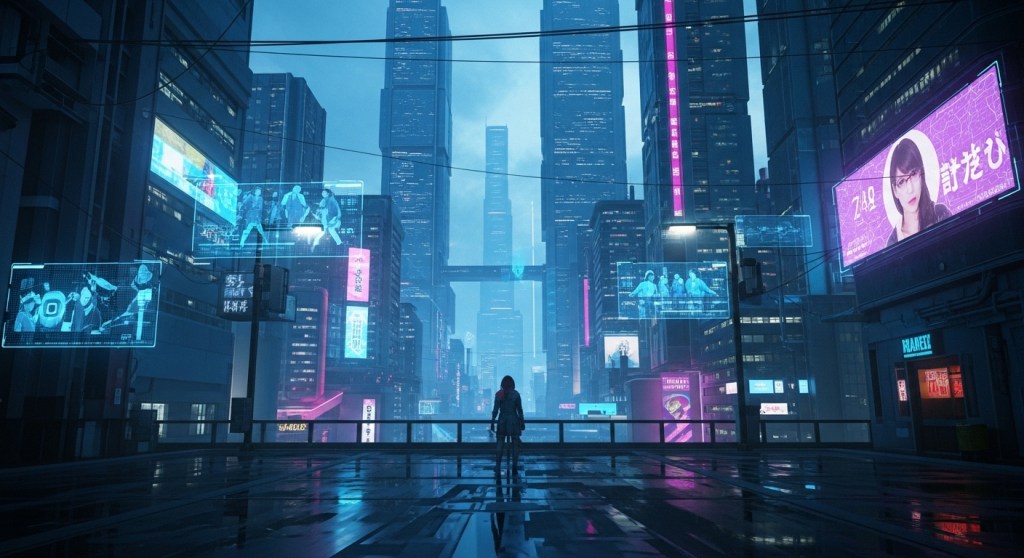
The Writing and Worldbuilding of the Cyberpunk Genre
The emergence of cyberpunk in the early 1980s represented a radical departure from the optimistic, often utopian trajectories of traditional science fiction. While earlier iterations of the genre envisioned technology as a tool for human transcendence or galactic expansion, cyberpunk localised the impact of the microchip within the grit of the urban sprawl.1 Defined by the evocative mantra “high tech, low life,” the genre explores the intersection of advanced scientific achievement and profound societal decay.3 This report examines the historical origins, philosophical foundations, major literary contributors, and stylistic nuances of cyberpunk, while delineating its critical differences from related subgenres such as steampunk and its subsequent evolution into post-cyberpunk and biopunk frameworks.
Historical Origins and the Cultural Revolution of the 1980s
The genesis of cyberpunk as a distinct literary movement is inextricably linked to the socio-economic and technological anxieties of the late 1970s and early 1980s. This era was characterised by the rise of personal computing, the burgeoning drug culture of the 1960s and 70s, and the nihilistic energy of the punk rock movement.1 The genre arose as a rebellion against what its founders perceived as a stagnant science fiction establishment, which often favoured clean, sterile futures and heroic protagonists.5
The term “cyberpunk” was famously coined by Bruce Bethke in his 1980 short story of the same name, which was later published in 1983.1 Bethke developed the term by creating two distinct lists of words—one for technology and one for troublemakers—experimenting with various combinations until he found a compound word that encompassed both punk attitudes and high technology.31 However, the movement was truly codified as a literary force through the convergence of two seminal works: Ridley Scott’s film Blade Runner (1982), based on Philip K. Dick’s Do Androids Dream of Electric Sheep?, and William Gibson’s novel Neuromancer (1984).8
Cyberpunk served as a response to the “New Wave” science fiction of the 1960s, which had begun to prioritise internal psychological landscapes over hard technological speculation.1 The cyberpunk authors, often referred to as “The Movement,” sought to bridge the gap between hard science and humanistic exploration. They envisioned a near-future where technology was not a remote, pristine force but a visceral, pervasive presence that had penetrated the human body and the domestic sphere.5
Technological Democratisation and the Shift in Perspective
The transition from the “Golden Age” of science fiction to the cyberpunk era can be understood through the lens of technological democratisation. Earlier science fiction often portrayed computers as massive, room-sized monoliths controlled by governments or benevolent scientists.5 The invention of the microchip in 1959 fundamentally shifted this perception, allowing for the miniaturisation of technology and its eventual integration into the everyday lives of the marginalised.5
In the 1950s and 60s, science fiction was largely optimistic, portraying robotic helpers as tools for leisure.5 By the 1980s, the “technological literacy” of the population had evolved into a mixture of ecstasy and dread.7 Technology was no longer a “bottled genie” of Big Science but a pervasive, intimate force that could be used for both empowerment and oppression.10
| Era | Key Technological Focus | Societal Outlook | Primary Setting |
| Golden Age (1940s-50s) | Rocketry, Nuclear Power | Optimistic / Expansionist | Deep Space / Utopian Cities |
| New Wave (1960s-70s) | Psychology, Sociology | Skeptical / Experimental | Earth / Inner Space |
| Cyberpunk (1980s) | Microchips, Cybernetics, VR | Dystopian / Hardboiled | Urban Sprawl / Cyberspace |
| Post-Cyberpunk (1990s-Present) | Biotech, Infospheres, Nanotech | Cautiously Optimistic | Integrated Global Society |
Philosophical Underpinnings: Post-Humanism and Corporate Feudalism
The philosophical core of cyberpunk is centred on the question of what it means to be human in a world where technology can replicate or replace human functions.1 The genre is built upon three primary pillars: post-humanism, post-industrialism, and post-nationalism.3 These themes collectively describe a world where traditional structures of identity and governance have collapsed in the face of technological and economic acceleration.
The Post-Human Condition and Transhumanism
Post-humanism in cyberpunk explores the transcendence of biological limits through technological intervention. Transhumanism is the movement advocating for the use of technology—such as genetic engineering, cybernetic implants, and AI integration—to enhance human capabilities and overcome biological limitations like ageing, disease, and death.3
In cyberpunk, this philosophy is often portrayed with a dark, cautionary edge. Characters are frequently depicted with “chromed” artificial limbs, neural implants, and sensory enhancements that blur the boundary between the biological and the artificial.5 The underlying aesthetic is often one of “transcending the flesh”.12 In Gibson’s Neuromancer, the protagonist Case views the human body as “meat”—a limitation to be escaped through the “consensual hallucination” of the Matrix.5 This raises troubling moral pitfalls: when everything about a person can be upgraded or replaced, the question remains of what is left of the original individual.3
Corporate Sovereignty and the Erosion of the Nation-State
The socio-political landscape of cyberpunk is defined by the rise of “mega-corporations” that have usurped the power of nation-states.3 In these settings, corporations possess their own paramilitary forces, territories, and legal systems, effectively establishing a modern form of “corporate feudalism”.3
The genre serves as a critique of late-stage capitalism, where mega-corporations control every facet of life, including housing, healthcare, and access to information.3 Governments are portrayed as either puppets of corporate interests or as “uber-governments” that work in a hybrid model of surveillance and data harvesting alongside corporate entities.3 This power dynamic ensures that justice is no longer a public right but a commodity that must be purchased.3
The Architects of the Digital Dystopia: Major Authors and Influential Works
The development of cyberpunk is linked to a small but highly influential group of writers who collaborated and competed during the 1980s. While William Gibson remains the most recognisable figure, others like Bruce Sterling, Neal Stephenson, and Pat Cadigan provided the intellectual and stylistic breadth that allowed the genre to flourish.
William Gibson: The Genesis of Cyberspace
William Gibson is universally regarded as the central figure in the cyberpunk movement.16 His 1984 novel Neuromancer is the most influential cyberpunk work, effectively spawning the entire movement.8 Gibson’s prose is noted for its density and its ability to evoke atmosphere through “information overload”.10 He introduced the concepts of “cyberspace”—a graphic representation of data abstracted from bank systems—and popularised the “console cowboy” archetype.5
Bruce Sterling: The Ideological Engine and “Chairman Bruce”
If Gibson provided the atmosphere of cyberpunk, Bruce Sterling provided its ideological manifesto. Sterling edited the seminal anthology Mirrorshades (1986), which defined the movement’s aesthetic and goals.10 Known as “Chairman Bruce,” he was one of the genre’s chief ideological promulgators.22 Sterling’s work often took a more global, socio-political view of technological change, exploring the “Shaper/Mechanist” conflict—a future where humanity splits into factions based on genetic engineering versus mechanical augmentation.20
Neal Stephenson: Satire and Linguistic Complexity
Neal Stephenson’s Snow Crash (1992) represents a pivot point in the genre. While maintaining the high-tech, low-life core, Stephenson added elements of satire and linguistic theory.15 He coined the term “metaverse” to describe an interconnected online reality that serves as an escape from a balkanised, corporate-owned America.15 His later historical works, such as The Baroque Cycle, further pushed the boundaries of worldbuilding.
Pat Cadigan and the “Queen of Cyberpunk”
Pat Cadigan is often referred to as the “Queen of Cyberpunk” or a “Cyberpunk Technofeminist” for her focus on the psychological and social implications of advanced technology. Her work, such as Synners (1991), explores the ontological crisis resulting from the loss of the “real” in the face of virtual reality and information overload. Cadigan’s exploration of neurochemistry and brain-computer interfaces added a necessary dimension to the genre’s focus on body modification.10
Rudy Rucker and “Transrealism”
Rudy Rucker, a mathematician and computer scientist, introduced a style known as “transrealism” to the genre. This method uses science fiction archetypes to symbolise the personal concerns of the characters, blending visionary technological speculation with quotidian, almost memoir-like authenticity. Rucker’s Ware tetralogy was pioneering in its depiction of evolved robot minds and the concept of transferring human personality to digital hardware.
C€yberpunk vs. Steampunk: Distinguishing Between Alternative Futures
While both cyberpunk and steampunk utilise the suffix “-punk” to denote a rebellion against established norms, they occupy vastly different temporal, technological, and philosophical spaces. The primary distinction lies in their relationship with history, technology, and the promise of progress.
Temporal and Technological Frameworks
Cyberpunk is essentially a near-future projection, looking ahead from the 1980s (or the present) to explore the consequences of current technological trends.4 Its technology is digital, electronic, and invasive, centred on silicon, software, and artificial intelligence.23
Steampunk, conversely, is a form of retro-futurism or alternative history.25 It reimagines the 19th-century Victorian era, asking what might have happened if steam-powered technology had continued to evolve in sophisticated, albeit analogue, directions.23 Its iconography includes brass gears, clockwork, airships, and steam engines.23
Tonal and Philosophical Divergence
The tone of cyberpunk is almost universally pessimistic and dystopian. It focuses on social decay, alienation, and the dehumanising effects of cold, efficient technology.15 In cyberpunk, the world is often described as a place of “man’s inhumanity to man,” where the masses are trapped in a system they cannot control.12
Steampunk is frequently more optimistic or adventurous, reflecting the “Victorian vigour” of its era.25 While it can contain dark elements—such as the exploitation of labour during the Industrial Revolution—it often balances this with a sense of wonder and the promise of a brighter tomorrow through industrial discovery.24
| Feature | Cyberpunk | Steampunk |
| Timeline | Near Future (Digital Age) | Alternative Victorian Past (Steam Age) |
| Primary Technology | AI, VR, Cybernetics, Silicon | Steam Engines, Clockwork, Analogue |
| Tone | Dystopian, Pessimistic, Noir | Optimistic, Adventurous, Romantic |
| Core Theme | “High Tech, Low Life” | “Retro-Futuristic Discovery” |
| Body Modification | Electronic Chips, Neural Jacks | Brass Limbs, Mechanical Gears |
| Power Structure | Corporate Hegemony / Digital State | Imperial Power / Industrial Revolution |
The Cyberpunk Writing Process: Techniques and Methodology
Writing in the cyberpunk genre requires a specific set of narrative strategies to convey the “high-tech, low-life” atmosphere effectively. This involves specialised dialogue, environmental storytelling, and a deliberate manipulation of the reader’s sense of clarity.
Physical Writing Habits and the “Buffer” Theory
The creators of high-tech fiction often used surprisingly low-tech tools. William Gibson famously wrote Neuromancer on a manual portable typewriter—a Hermes 2000—noting that in 1981, he knew no one who wrote on a computer.40 Neal Stephenson, conversely, switched to writing with fountain pens for his multi-novel Baroque Cycle, believing the slower physical process acted as an “accumulation buffer” for the brain. This slow pace allows ideas to mature and “purify” before they are serialised on paper, preventing “half-baked” prose.
Slang Creation and Linguistic Invention
The creation of a unique lexicon is central to cyberpunk worldbuilding. Bruce Bethke’s “two list” method—combining technological terms with social labels—remains a standard technique for coining new genre terms.31 Effective fictional slang typically follows specific rules:
- Ease of Pronunciation: Terms should be short, often portmanteaus of existing words (e.g., “Netrunner” or “Cyberdeck”).
- Etymological Decay: Slang often arises from the corruption or contraction of existing technical terms.
- Cultural Significance: Slang is used by “insiders” to signify membership in a group and disdain for “Olders” or the uninitiated.
Style and Narrative Techniques
- The “Confusion” Technique: Authors avoid “spoon-feeding” explanations. Readers must work to decode jargon and infer meaning, mimicking the experience of a “tourist” in a high-tech future.4
- Hardboiled Prose: Cyberpunk language often mirrors the “noir” crime fiction of Raymond Chandler or Elmore Leonard, using clipped, visceral descriptions.4
- Information Overload: Dense descriptions and technical jargon are used to overwhelm the reader’s senses, creating a feeling of immersion in a hyper-stimulated environment.10
| Term | Meaning | Origin / Context |
| Cyberspace | A graphic representation of data abstracted from banks. | William Gibson, Neuromancer.5 |
| Flatline | To die, often while connected to the digital Matrix. | Refers to a flat EEG trace.29 |
| Black Ice | Lethal security software that can kill a hacker. | “Ice” = Intrusion Countermeasures Electronics.29 |
| Choomba / Chummer | Slang for a friend or buddy. | Cyberpunk 2020 / Street culture.30 |
| Chop Shop | A black clinic for illegal cyberware installation. | Street slang.29 |
Narrative Arcs and Character Archetypes: The Anti-Hero vs. The System
Cyberpunk narratives typically feature “marginalised, alienated loners” who live on the edge of a dehumanised society.2 The protagonist is rarely a classic hero; they are more often an anti-hero—a hacker, a street samurai, or a disgraced lawman—who is motivated by survival rather than altruism.4
The narrative arc in classic cyberpunk is often “noir-inflected,” featuring a mystery or a small-scale problem that reveals the deep corruption of the broader society.3 Because the protagonist is an individual fighting against an entire corporate-technological apparatus, the “good ending” is rarely the destruction of the system; instead, it is usually the preservation of the character’s self-identity or their survival in a world that sees them as “nothing more than tools to be used and discarded”.11
The Evolution of the Genre: From Classic Cyberpunk to Post-Cyberpunk and Biopunk
As digital technology became mainstream in the 1990s and 2000s, the “classic” tropes of cyberpunk began to evolve. The internet, which had been a speculative “consensual hallucination” in 1984, was now a daily reality, leading writers to explore new frontiers of speculation.9
Post-Cyberpunk: Integration and Mundane Realities
Post-cyberpunk emerged as a response to the nihilism of the 1980s. While it retains futuristic elements like human augmentation and ubiquitous infospheres, it forgoes the mandatory assumption of a total dystopia.13 Post-cyberpunk characters are often “integral members of society”—they have families, jobs, and a vested interest in maintaining social order.35 The tone is more “cautiously optimistic,” focusing on the mundane absurdities and political implications of technology rather than total societal collapse.13
Biopunk: The Revolution of Wetware
Biopunk focuses on the potential dangers and societal impacts of synthetic biology and biotechnology.36 In these stories, the “invasion” of the body is achieved through recombinant DNA, genetic splicing, and chromosomal modification rather than mechanical prosthetics.35 The conflict often involves individuals struggling against totalitarian governments or corporations that misuse biotechnology for social control.37 Works like The Windup Girl by Paolo Bacigalupi explore the ethical implications of a society divided by genetic status.21
| Subgenre | Primary Technological Focus | Societal Tone | Character Role |
| Cyberpunk | Silicon / Software / AI | Dystopian / Nihilistic | Marginalised Outsider |
| Post-Cyberpunk | Infospheres / Integrated Networks | Cautiously Optimistic | Productive Member of Society |
| Biopunk | DNA / Splicing / Biotech | Visceral / Cautionary | Victim of Experimentation |
| Solarpunk | Renewable Energy / Green Tech | Optimistic / Utopian | Community-Oriented Builder |
The Enduring Significance of the Digital Underground
The analysis of cyberpunk reveals a genre that is fundamentally concerned with the tension between advanced technological achievement and the persistent inequalities of human society. Its core tenets—high tech, low life—provide a framework for critiquing the current trajectory of human civilisation.
- Technological Literacy is a Survival Skill: In cyberpunk, technology is not just an external tool but a “visceral” presence that permeates the body and mind. Survival in this world requires an intimate understanding of the systems that both empower and oppress the individual.4
- Identity is Fluid and Contested: The merger of man and machine raises existential questions about the soul and the continuity of the self. The genre warns that without a firm grasp on identity, the individual becomes merely a tool for corporate or bureaucratic interests.3
- Resistance Occurs in the Cracks: While the “system” is often portrayed as insurmountable, the “punk” element of the genre emphasises the power of the marginalised to subvert technology for their own purposes, carving out spaces of freedom within a controlled environment.5
As we navigate an era of unprecedented digital integration, the themes and aesthetics of cyberpunk remain strikingly relevant, serving as both an exhilarating vision of potential and a cautionary tale about the costs of unchecked progress.9
Works cited
- Understanding What Aesthetic is Cyberpunk: Key Features and Elements – Cyber Techwear, accessed on February 19, 2026, https://cyber-techwear.com/blogs/techwear-blog/understanding-what-aesthetic-is-cyberpunk-key-features-and-elements
- Cyberpunk | Neo-noir, Sci-Fi, Dystopia – Britannica, accessed on February 19, 2026, https://www.britannica.com/art/cyberpunk
- The Ultimate Guide to the Cyberpunk Genre for 2025 – J. Paul Roe …, accessed on February 19, 2026, https://jpaulroe.com/the-ultimate-guide-to-the-cyberpunk-genre-for-2025/
- How to Write Cyberpunk | Liminal Pages, accessed on February 19, 2026, https://www.liminalpages.com/how-to-write-cyberpunk/
- The Philosophy of Cyberpunk: High-Tech Rebels and Neon Dreams – New Intrigue, accessed on February 19, 2026, https://newintrigue.com/2025/01/15/the-philosophy-of-cyberpunk-high-tech-rebels-and-neon-dreams/
- Cheap Truth – Wikipedia, accessed on February 19, 2026, https://en.wikipedia.org/wiki/Cheap_Truth
- Cyberpunk in the Nineties, accessed on February 19, 2026, http://project.cyberpunk.ru/idb/cyberpunk_in_the_nineties.html
- What is Cyberpunk? – Jon Richter, accessed on February 19, 2026, https://www.jon-richter.com/post/what-is-cyberpunk
- Cyberpunk: From Literary Revolution to Cultural Phenomenon | Morph Studio, accessed on February 19, 2026, https://www.morphstudio.com/article/cyberpunk-from-literary-revolution-to-cultural-phenomenon
- Notes on the Cyberpunk Moment – Pop Junctions, accessed on February 19, 2026, http://henryjenkins.org/blog/2015/05/notes-on-the-cyberpunk-moment.html
- High Tech, Low Life – CREATED, accessed on February 19, 2026, https://created.beckandstone.com/high-tech-low-life/
- What separates a cyberpunk setting from a futuristic setting? – Sci-Fi Stack Exchange, accessed on February 19, 2026, https://scifi.stackexchange.com/questions/114587/what-separates-a-cyberpunk-setting-from-a-futuristic-setting
- Whats the difference between cyberpunk and post-cyberpunk? : r/CoreCyberpunk – Reddit, accessed on February 19, 2026, https://www.reddit.com/r/CoreCyberpunk/comments/ilmuw7/whats_the_difference_between_cyberpunk_and/
- Fusing Low Life With High Tech Within Your Cyberpunk Story, accessed on February 19, 2026, https://www.servicescape.com/blog/fusing-low-life-with-high-tech-within-your-cyberpunk-story
- Neon & Noir: Cyberpunk Worldbuilding for RPGs & Fiction, accessed on February 19, 2026, https://academy.worldanvil.com/blog/cyberpunk-worldbuilding-guide
- The Best Cyberpunk Novels – Five Books Expert Recommendations, accessed on February 19, 2026, https://fivebooks.com/best-books/the-best-cyberpunk-novels-jared-shurin/
- Best Cyberpunk Books Ever – Tim Hawken, accessed on February 19, 2026, https://www.timhawken.com/blog/2023/1/6/best-cyberpunk-books-ever
- Three Tips For Writing (Cyberpunk) “Flash Fiction” Stories | PekoeBlaze – WordPress.com, accessed on February 19, 2026, https://pekoeblaze.wordpress.com/2017/08/20/three-tips-for-writing-cyberpunk-flash-fiction-stories/
- Understanding Cyberpunk: Its Origins, Influence, and Impact – Imaphotic, accessed on February 19, 2026, https://www.imaphotic.com/blogs/entertainment/cyberpunk-history-relevance
- Bruce Sterling | What’s new, new media? | Fandom, accessed on February 19, 2026, https://newmedia.fandom.com/wiki/Bruce_Sterling
- The Cyberpunk Countdown: 10 Essential Genre Reads That Shaped Me – schulz:dk, accessed on February 19, 2026, https://schulz.dk/2024/11/26/the-cyberpunk-countdown-10-essential-genre-reads-that-shaped-me/
- Bruce Sterling – Wikipedia, accessed on February 19, 2026, https://en.wikipedia.org/wiki/Bruce_Sterling
- Steampunk and Cyberpunk: the differences, accessed on February 19, 2026, https://my-steampunk-style.com/blogs/steampunk-blog/steampunk-and-cyberpunk
- Would you say it’s true that Steampunk tends to look to the past, while cyberpunk tends to look to the future, in-terms of settings? – Quora, accessed on February 19, 2026, https://www.quora.com/Would-you-say-its-true-that-Steampunk-tends-to-look-to-the-past-while-cyberpunk-tends-to-look-to-the-future-in-terms-of-settings
- [Setting] how is Steampunk different from Cyberpunk aside from the aesthetic? – Reddit, accessed on February 19, 2026, https://www.reddit.com/r/AskScienceFiction/comments/1hplmr8/setting_how_is_steampunk_different_from_cyberpunk/
- Steampunk vs Cyberpunk – Reddit, accessed on February 19, 2026, https://www.reddit.com/r/steampunk/comments/p6k313/steampunk_vs_cyberpunk/
- Steampunk vs. Cyberpunk: A Tale of Two Futures – Oreate AI Blog, accessed on February 19, 2026, https://www.oreateai.com/blog/steampunk-vs-cyberpunk-a-tale-of-two-futures/f9d6c55a7de9debad5095e1d66a05029
- (PDF) Cyberpunk as a Means of Expressing High-tech …, accessed on February 19, 2026, https://www.researchgate.net/publication/367570445_Cyberpunk_as_a_Means_of_Expressing_High-tech_Counterculture_Formation
- Cyberpunk Glossary – I made this!, accessed on February 19, 2026, https://orrange.tripod.com/glossary.html
- Cyberpunk words/phrases | Trese Brothers – ProBoards, accessed on February 19, 2026, https://startradersrpg.proboards.com/thread/1897/cyberpunk-words-phrases
- Cyberpunk – Wikipedia, accessed on February 19, 2026, https://en.wikipedia.org/wiki/Cyberpunk
- Cyberpunk and the Hardboiled Detective – B.K. Bass, Author and Editor, accessed on February 19, 2026, https://bkbass.com/essays-articles-and-musings/genre-studies/cyberpunk-and-the-hardboiled-detective/
- Cyberpunk vs Post-Cyberpunk – Reddit, accessed on February 19, 2026, https://www.reddit.com/r/Cyberpunk/comments/14hp47s/cyberpunk_vs_postcyberpunk/
- The evolution of cyberpunk realia in video games, accessed on February 19, 2026, https://dl.digra.org/index.php/dl/article/download/1328/1328/1325
- Cyberpunk derivatives – Wikipedia, accessed on February 19, 2026, https://en.wikipedia.org/wiki/Postcyberpunk
- Why Biopunk isn’t necessarily Cyberpunk – Reddit, accessed on February 19, 2026, https://www.reddit.com/r/Cyberpunk/comments/6ajb55/why_biopunk_isnt_necessarily_cyberpunk/
- Cyberpunk derivatives – Wikipedia, accessed on February 19, 2026, https://en.wikipedia.org/wiki/Cyberpunk_derivatives
- The evolution of cyberpunk: steampunk, biopunk, nanopunk, atompunk, clockpunk, solarpunk, dieselpunk – YouTube, accessed on February 19, 2026, https://www.youtube.com/watch?v=2-96gYtDzsE
- Why is Biopunk a separate genre? : r/Cyberpunk – Reddit, accessed on February 19, 2026, https://www.reddit.com/r/Cyberpunk/comments/1j9hwi7/why_is_biopunk_a_separate_genre/
- William Gibson: Physical Writing Process – Joseph Patrick Pascale, accessed on February 19, 2026, https://www.josephpatrickpascale.com/post/physical-writing-process-pt-2
- Advice from the Masters: William Gibson – Write Your Book with Wally, accessed on February 19, 2026, https://writingabookwithwally.com/better-writing/advice-from-the-masters-william-gibson
 The Original Writers Group
Really helpful post and references.
I’m also exploring Truetopia through my short stories
thank you
LikeLike