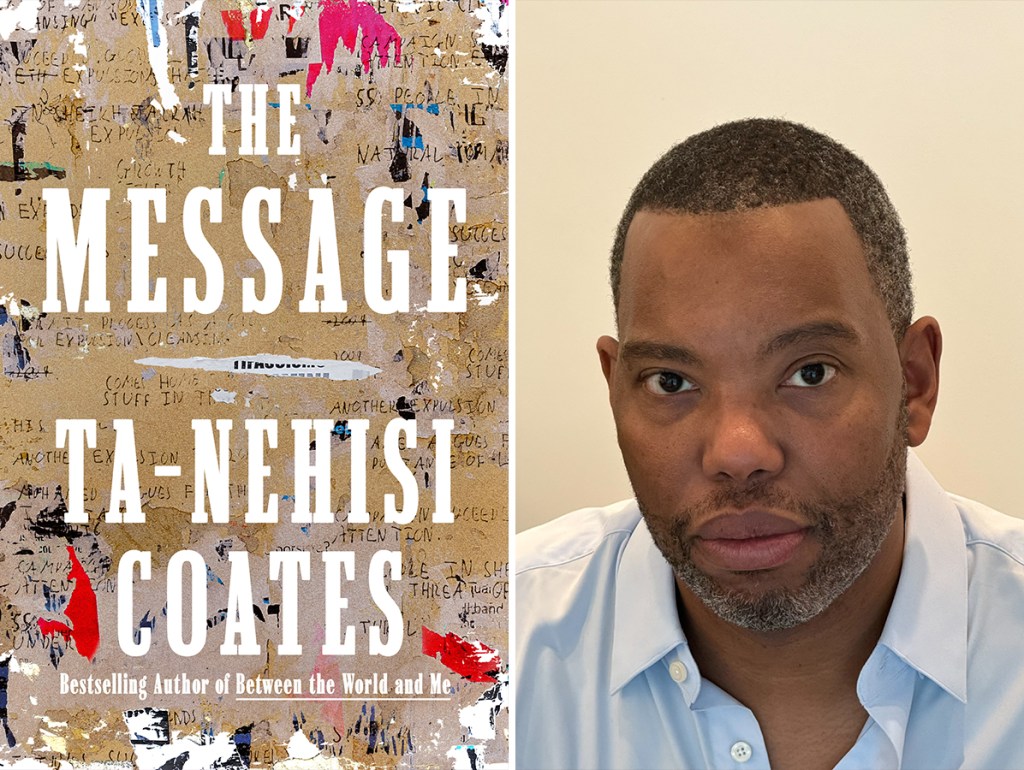

Ta-Nehisi Coates, The Message, and the Physical Courage of Writing

For any collective of writers, whether aspiring novelists, seasoned journalists, or poets navigating the quiet solitude of the draft, the figure of Ta-Nehisi Coates stands as a singular, provocative study in the power of the written word. He is not merely a commentator on the American condition; he is a craftsman who has systematically dismantled the boundaries between memoir, history, journalism, and fantasy to forge a voice that is arguably the most distinct in contemporary English letters. With the publication of his latest work, The Message (2024), Coates has returned to nonfiction after a seven-year hiatus, offering a series of essays on conflict that, at its heart, is a reflection on the ethical and political mandates of the writer.

Coates offers a methodology. His career — from the scrappy, precarious days of freelancing in West Baltimore to his current status as a literary titan and Senior Staff Writer for Vanity Fair — is a testament to the rigour of writing as a discipline rooted in what he calls “physical courage” — the will to confront the “horribleness” of one’s own early drafts and the resilience to refine them until they sing.

To understand how Coates writes, one must appreciate the crucible in which his intellect was forged. He was not a product of the Ivy League or the traditional MFA conveyor belt. His education was distinctly autodidactic, curated by the dual forces of a revolutionary father and a disciplinarian mother in the hard streets of West Baltimore.

Born in 1975, Coates grew up in a household that functioned as a sovereign state of Black intellect. His father, William Paul Coates, was a former Black Panther who founded Black Classic Press, a publishing house dedicated to reprinting forgotten works of African and African-American history. Consequently, the young Ta-Nehisi did not grow up seeing books as distant artefacts of the academy; they were the furniture of his life. His mother, Cheryl Lynn Coates, was a teacher who instilled in him the connection between writing and accountability. When he misbehaved at school, the punishment was often an essay. He was required to investigate his actions and write in order to explain himself to the world. This early conflation of writing with survival — the idea that if you can describe your reality, you can perhaps endure it — is the bedrock of his style.

In 1993, Coates enrolled at Howard University, an institution he writes about in his work as “The Mecca”. He left without a degree and, by his own admission, was a “terrible student” in the conventional sense, drifting through classes and failing to adhere to the syllabus. However, this academic failure masked a voracious, self-directed study as he spent his time in the Moorland-Spingarn Research Center, devouring history books that answered questions burning in his mind, rather than those posed by his professors. He used the university as a laboratory, and it was here he learned that ‘the Dream of American Innocence’ was a fabrication, and that the writer’s job was to puncture it.

The years following Howard were defined by economic precarity. Coates worked for The Washington City Paper, where he met his mentor, the late David Carr. Carr taught him the mechanics of the trade — how to report, how to verify, and most importantly, how to type until the story works. Coates often speaks of this period as “the wilderness,” a time of unemployment and struggle that stripped him of any romantic notions about the writing life. He learned that writing is a job, a trade that requires showing up even when the inspiration — and the paycheck — is absent.

Coates has been transparent about his writing process. He rejects the idea of the Muse and instead frames his writing as an act of “physical courage”. He argues that the difficulty of writing lies in the gap between the perfect idea in one’s head and the clumsy, inadequate sentences that appear on the page. “The challenge of writing,” he says, “is to see your horribleness on page. To see your terribleness, and then to go to bed, and wake up the next day and take that horribleness and that terribleness and refine it, and make it not so terrible… And then one more time, if you’re lucky, maybe you get to good.”

This philosophy of pressure is central to his work. He believes that creative breakthroughs result from putting “an inordinate amount of pressure on yourself”. It is a muscular, almost athletic approach to creativity. You do not wait for the flow; you force the brain to forge new connections through the stress of the attempt. When editing ‘Between the World and Me’ he printed out the draft, numbered the paragraphs, and then physically retyped the entire book from scratch.

The reason for Coates was that typing is rhythmic. “When you run it through your brain again, you say things better,” he explains. “The writing’s such a physical activity. It’s not just mental, the typing actually does matter.” By retyping, he could feel the cadence of the sentences, ensuring that the rhythm — the “music” — was consistent. He is heavily influenced by hip-hop, specifically the intricate lyricism of Rakim and soul music. He listens to music constantly, trying to transfer the emotional ache of a Marvin Gaye vocal into the structure of his paragraphs. He uses rhetorical devices like anaphora (repetition of a word or phrase at the beginning of successive clauses), biblical cadences, and a rejection of “purple prose” in favour of muscular, direct verbs. Research: “Walking the Land”

“I want them to read something and then walk away and be haunted by it… I want them to not be able to sleep because of it.” 

Coates is not a desk-bound thinker. In The Message, he emphasises that you cannot act upon what you cannot see. He advises his students that writing is tangible and felt, not abstract. He travels extensively for his writing — Paris, Senegal, the West Bank. He calls this “walking the land”. He believes that the writer must physically place their body in the story space to feel the soil and the reality of the terrain. 

Published in October 2024, The Message is perhaps Coates’s most ambitious attempt to link the craft of writing with the politics of liberation. Originally conceived as a writing guide for his students at Howard — modelled on Orwell’s Politics and the English Language — it evolved into a triad of essays exploring how stories are used to oppress and how they can be used to liberate.

The book is divided into three interwoven essays, each centred on a journey:

  1. Dakar, Senegal: A confrontation with the myths of ancestry.
  2. Columbia, South Carolina: A confrontation with the myths of the Confederacy and censorship.
  3. Palestine: A confrontation with the myths of Zionism and nationalism.

The central thesis of The Message is that “politics is the art of the possible, but art creates the possible of politics.” Coates argues that the stories nations tell themselves — about their origins, their innocence, their rights — are the architecture that supports their political actions. Therefore, the writer’s job is to dismantle the “dead language” and “destructive myths” that obscure reality.

Essay 1: The Phantom Kingdom (Senegal)

In the first essay, Coates travels to Dakar and researches the Afrocentric myths he grew up with — the idea of an African “Eden” interrupted by slavery. He visits Gorée Island and the “Door of No Return.” He knows the site’s narrative is contested and likely exaggerated for tourism. Yet, he finds a validity in the myth because of the emotional truth it holds for the diaspora. He teaches us that a writer must distinguish between historical fact and emotional truth, and that sometimes, the ghosts of a story are more real than the statistics.

Essay 2: The Battle for the Classroom (South Carolina)

This section is relevant for any writer concerned with censorship. Coates visits a school board meeting in South Carolina, where a teacher, Mary Wood, is threatened for teaching Between the World and Me. He observes that the banning of books is a compliment to the power of the writer. If writing were harmless, the state would not bother to suppress it. He frames the comfort of students (the reason often given for banning uncomfortable history) as a tool of erasure. For the writer, the lesson is clear: do not write to comfort; write to clarify.

Essay 3: The Gigantic Dream (Palestine)

The final and longest essay details Coates’s journey to the West Bank and East Jerusalem. This is the section that ignited a firestorm of controversy, including a contentious interview on CBS Mornings where anchor Tony Dokoupil questioned if the book belonged in the “backpack of an extremist”.

Coates applies the same lens to Israel/Palestine that he applies to Jim Crow America. He rejects the call for complexity, arguing that it is often a stalling tactic used by power to prevent moral judgment. He describes the segregation of water, roads, and rights, drawing a direct line between the Jim Crow South and the Occupied Territories.

For writers, the takeaway here is the courage to trust one’s eyes. Coates admits he felt lied to by his craft — that the mainstream media narratives he had consumed had obscured the reality on the ground. He believes the writer’s loyalty must be to the voiceless, even when that stance invites criticism.

While The Message is his current focus, Coates’s versatility offers further lessons for writers who feel pigeonholed into a single genre.

The Water Dancer (2019)

In his debut novel, Coates translated his obsession with memory into a magic system. The protagonist, Hiram Walker, possesses the power of “Conduction” — the ability to transport people across great distances using the power of memory. Here, Coates literalises his non-fiction thesis: that memory is the tool of liberation. For fiction writers, this serves as a masterclass in building a magic system that is thematically resonant rather than just mechanically cool.

The Comic Book Scripts

Coates’s runs on Marvel’s Black Panther and Captain America (2016–2021) were not mere side projects. They were dense political allegories.

  • Scripting vs. Prose: Coates had to learn a new language for comics. He realised that “You can’t say, ‘In this year, this happened.’ You actually have to think, ‘What does this look like?'” 
  • Political Allegory: In Captain America, he introduced the “Power Elite” and reimagined the villain Red Skull as an internet intellectual radicalising young men — a direct commentary on the rise of the alt-right. In Black Panther, he questioned the very concept of monarchy, asking, “Can a good man be a king?” He proved that genre fiction can bear the weight of serious political inquiry without losing its entertainment value.

As of late 2025, Coates has accepted a new role as a Senior Staff Writer for Vanity Fair, signalling a return to the kind of long-form, culture-defining journalism that made his name at The Atlantic. But his primary message remains directed at the student — the developing writer.

The Writer’s Syllabus

For those looking to emulate his reading diet, Coates recommends a mix of history and literature that refuses to comfort the reader. His “syllabus” often includes:

  • The Fire Next Time by James Baldwin (the template for his epistolary style).
  • Postwar by Tony Judt (for its refusal of “solutionism”).
  • The Battle Cry of Freedom by James McPherson (for the history of the Civil War).
  • The poetry of Yusef Komunyakaa and Carolyn Forché (for rhythm and the power of what is not said).

Ta-Nehisi Coates shows us that writing is not a safe profession. It is an act of exposure and requires us to travel to uncomfortable places. It demands that we reject the dead language of clichés and state-sanctioned myths in favour of a clarity that haunts the reader long after they have closed the book.

“I don’t want them to agree with me,” Coates says. “I want them to read something and then walk away and be haunted by it.”


Key Takeaways for Your Writing Practice:

  1. Embrace the “Horribleness”: Do not fear the bad draft. The real work happens in the retyping and the refining.
  2. Find Your Rhythm: Read your work aloud. Retype it to feel the beat. Listen to music that captures the emotional tone you want to convey.
  3. Walk the Land: Do not rely on Google. Go to the place. See the soil. The specific sensory detail is worth a thousand generalisations.
  4. Question the “Complexity”: Do not let the demand for “nuance” stop you from stating moral truths clearly.
  5. Write to Haunt: Aim for an emotional resonance that lingers like a melody.

Helen Garner and the Narrative Construction of Self in ‘How to End a Story’

Helen Garner

Helen Garner, born in 1942, is widely recognised as one of Australia’s most significant contemporary literary figures. Her career spans multiple genres, including those of novelist, short-story writer, journalist, and screenwriter. Educated at the University of Melbourne, her literary debut, Monkey Grip (1977), was explosive, immediately establishing her as an original and often controversial voice on the Australian literary scene. Her influential body of work spans decades, encompassing celebrated fiction such as The Spare Room (2008) and high-profile non-fiction investigations, including The First Stone (1995), Joe Cinque’s Consolation (2004), and This House of Grief (2014).

Garner’s stature in Australian letters is immense; the ABC has lauded her as one of the country’s “most important and admired writers”, and The Guardian has referred to her as “Australia’s greatest living writer.” Her work has attracted numerous accolades, including the Walkley Award (1993) and the prestigious Baillie Gifford Prize for non-fiction (2025). However, her prominence is often inextricably linked to controversy. Garner is simultaneously “revered and divisive.” While widely admired for her “scalpel-sharp honesty and a kind of moral courage,” she has faced significant criticism, particularly from feminists who took issue with her stance in The First Stone, leading to deep literary resentments that persist among certain critics and readers. This contentious reputation stems directly from her willingness to explore the messy, complex, and often ambiguous “fault lines” — social, sexual, and moral — of contemporary Australian life, always filtered through a fiercely personal, unflinching perspective.

Her distinctive methodology is founded upon the strategic blurring of genres, particularly the intermingling of memoir, journalism, and fiction, a practice frequently termed autofiction. Her reputation for incorporating and adapting personal experiences into her fiction is long-standing, attracting both widespread attention and critical scepticism. Early in her career, some critics dismissed Monkey Grip as merely “her diary,” while later commentators questioned whether The Spare Room was truly a novel. Garner’s sophisticated rebuttal to this critique is central to understanding her writing process: she maintains that when drawing from life for her novels, the conscious acts of selection, ordering, and narrative construction transform the raw material into legitimate art.

The challenge for readers and critics lies in disentangling the “real and unknowable Garner” from the “Garner as author.” The self presented in her work — the “I” or “Helen” inserted into narratives ranging from novels to court reports — is fundamentally a literary construct. Readers often become deeply immersed in this constructed subjectivity, developing an intense “fandom” that frequently confuses the authorial persona with biographical fact. The sustained power of Garner’s prose relies on this strategic self-exposure, which creates a vital illusion of unfiltered authenticity and thereby establishes a deep sense of trust with the reader, even when the topics are morally ambiguous. The methodological implication is that her writing process involves a conscious, meticulous calculation of which aspects of her identity and experience to deploy to serve the narrative’s objective of truth-telling.

The defining characteristic of Garner’s literary ethos is her commitment to achieving “A bare-knuckle kind of truth.” This demanding mission statement dictates a style that seeks to confront rather than comfort the reader. The pursuit of this raw truth necessitates a high degree of personal and moral candour, which few writers attempt or survive across four decades.

How to End a Story: Diaries: 1995–1998 represents the third published volume of Garner’s personal journals and holds unique significance as a direct document of her creative process. The volume, published in 2021, garnered the prestigious Baillie Gifford Prize for Non-Fiction in 2025, underscoring its literary merit beyond mere documentation.

The diaries offer the most direct, albeit still highly curated, access to the author’s contemporaneous consciousness and the raw, unedited observational data that fuels her artistic output. Crucially, the title itself provides a primary lens for process analysis. The framing, How to End a Story, imposes a formal, structural coherence upon what was originally the chaotic, diaristic documentation of daily life. This title suggests the diaries are organised thematically around a narrative arc of dissolution, specifically the end of her third marriage, thereby transforming the text from a private record into a public artefact of literary structure and creative methodology.

The period covered by How to End a Story is one of turbulence in Helen Garner’s personal and professional life. The years 1995 through 1998 document the painful, unravelling stages of her third marriage to writer Murray Bail (1992–2000). The diary entries detail the friction of being married to a fellow writer, observing that while Bail was “theoretical” and focused solely on work, Garner was “emotional” and “longed for more.” The text candidly reveals the marriage breakdown, portraying Bail in a difficult light, sometimes as “cold and a bully,” documenting the unhappy reality that neither spouse would immediately admit. The material captures the emotional guts and complexity associated with marital strife, functioning as a form of raw autofiction. The publication of the journals proves the enduring truth that the value of writing is “firstly, for oneself,” turning internal anguish into externalised prose.

Concurrently, this era saw the massive public fallout from The First Stone, published in 1995. The diaries provide a real-time account of the backlash and “notoriety” Garner faced, particularly from segments of the feminist movement who, in her view, preferred “their truth in absolutes” over her “nuanced examination of a university sexual-harassment case.”

The intense overlap between profound personal suffering (the divorce) and significant professional controversy (the backlash) is integral to the diaries’ literary power. This confluence of crises forced a heightened state of self-examination and raw observational acuity. The emotional pressure of the disintegration of her marriage, coupled with the heat of the public debate, resulted in passages noted for their “white hot” anger and “distilled acuity.” This dynamic demonstrates a recurring pattern in Garner’s creative life: her most powerful prose often emerges from intense personal and professional discomfort, suggesting a causal relationship between suffering and clarity. The diary, in this context, serves as the primary instrument for processing life’s painful “fault lines.”

The journals published in How to End a Story are recognised for their exceptional literary quality, with critics praising their depth and sustained excellence. One reviewer described them as potentially “the greatest journals since Virginia Woolf’s.” The volume is substantial, running to more than 800 pages, and is characterised by the consistently “distilled acuity and brilliance” found on virtually every page. The content is unflinchingly candid, laying bare “the most intimate details of her life,” including her reflections on ageing, struggles with mental health, and the indignities of relationship failure.

The transformation of these vast, raw daily jottings into a critically acclaimed published text is a crucial aspect of Garner’s writing process. Prize judges noted that the volume possesses a “real narrative drive,” which is significant, as raw diaries are typically fragmented and meandering. The maintenance of narrative momentum across 800 pages requires rigorous editorial intervention. The implication is that the process of creation for this book involved far more than simply printing the original entries; it necessitated sophisticated post-hoc editing, selection, and structural manipulation by Garner and her publishing team.

The ultimate published text, How to End a Story, is therefore not merely raw documentation but a highly skilled narrative performance. The process of structuring the book involved achieving critical distance years later, enabling Garner to select and sequence entries that emphasise the emotional climax and thematic coherence of the marriage’s disintegration. This editorial strategy elevates the document from a collection of private observations into a structured narrative that successfully maintains momentum, employing the exact construction skills — selection, ordering, and framing — that she uses to defend her autofictional novels as works of art.

Perhaps the most compelling aspect of the publication of How to End a Story, from a process standpoint, is the ethical challenge inherent in publishing personal journals during the author’s lifetime. Critics typically argue that diaries should only be published posthumously to avoid exploiting or damaging the subjects within. Garner’s decision to proceed with publication, subjecting herself to scrutiny regarding self-doubt, unravelling marriages, and “scorching observations,” has been described as an act of “sheer unwavering bravery.”

This act of publication is made more complicated by the fact that Garner previously “burned diaries dating from an earlier period,” confirming her awareness of the potentially destructive nature of these private records. Her eventual decision to publish suggests a deliberate, possibly agonising, pact made with herself regarding the limits of self-exposure.

In this specific context, the ethical trade-offs inherent in life-writing are unavoidable. The diaries expose the vulnerabilities and negative characteristics of others, particularly Murray Bail. This dynamic brings into sharp relief the renowned statement by Joan Didion: “Nonfiction is never immaculately honest. Writers, as Joan Didion said, are always selling someone out.” The process of editing and selecting these entries required not just artistic judgement but a profound moral review. The published result suggests that Garner determined the creative and moral value of the narrative — specifically, its capacity to provide an “acknowledgement of how things truly are for women” — justified the ethical compromise of exposing private lives. This willingness to embrace ethical friction is central to her method of achieving the “bare-knuckle truth,” making the boundary dispute between art and morality itself a key, enduring theme of her work.

Garner’s writing process is driven by a moral aesthetic rooted in candour. Her stated goal is not to soothe or confirm existing beliefs but to write “to confront” the reader. This demanding objective requires “personal and moral candour” and a refusal to flinch from complexity. This moral courage translates directly into her methodology for tackling difficult subjects, whether they involve marital collapse or true crime. She is described as being both “confessional” and “forensic.” In works like This House of Grief, where she chronicles a murder trial, her process involves meticulous observation — watching, listening, and recording not just the legal proceedings but the devastating emotional fallout. Critically, she employs a process of restraint, refusing to “mandate feelings” or attempt to definitively solve the crime. Instead, she allows herself and the reader to feel the full weight of complexity, maintaining “ambivalence” and managing to “hold judgment and empathy in the same breath.”

To successfully convey this nuanced moral complexity without rhetorical confusion, Garner’s drafting and editing process must prioritise linguistic clarity and sparseness. The text must present complex emotional and factual data without the interference of rhetorical flourishes or sentimental language. The goal is distillation: stripping away judgementalism or overwrought prose to reveal the uncomfortable emotional fact beneath. This aesthetic choice is a necessary operational step to ensure that the precision of her language supports the complexity of her moral position.

The Daily Practice: Unconscious Collection and Accepting Futility

Garner has discussed the specific mechanics of her discipline, which combines rigorous scheduling with a form of mental surrender. For structured projects, such as a regular column, she adheres to a specific weekly routine. During the days when she consciously forbade herself to focus on the writing task, she describes her unconscious mind as working “busily in the dark, noticing and collecting and amassing,” so that when she finally allowed herself to write, much of the “preliminary work had already been done.” This suggests a two-stage process: a period of intense, passive absorption and collection, followed by a highly concentrated phase of conscious organisation and drafting.

She employs a unique technique for overcoming the common creative hurdle of writer’s block, which she describes as the feeling of “futility” or having nothing to say. Her approach is counter-intuitive: rather than trying to overcome the block by force, which leads to physical stress (“my head begins to ache”), she chooses to “accept this futility, give up my purpose to write, and yet don’t run away into some other activity.” This strategy of disciplined non-forcing is likely a key mechanism for achieving the spontaneous “jewels” and “distilled acuity” that critics praise in her diaries. The process ensures that the collected observational data, accumulated in the diary and the unconscious, surfaces naturally when the mental resistance is lowered.

Garner’s diaries offer a direct view of her internal creative anxiety. She is relentlessly self-critical, confessing worries that she “lacks sufficient skill as a writer” and that her subjects are “too small.” The diaries reveal a history of self-flagellation, shifting from “youthful narcissism” and “puritanical savageness” to a later self-perception as “sturdy though battle-scarred.”

This intense personal scrutiny must be balanced against her defence of her art. Garner firmly asserts that the choice, ordering, and construction of narrative — even when drawing directly from life — are what define her work as art rather than mere raw documentation. This distinction is vital for understanding her writing process. The existence of the published diaries, such as How to End a Story, provides crucial metacritical material. Literary studies emphasise that Garner’s life and writing are inextricably linked, making it impossible to understand one without probing the other.

By publishing her journals, Garner inadvertently creates a mechanism for critics to test her claim: how much did she select, order, and construct in her acclaimed autofictional novels (like Monkey Grip) compared to the selection process employed for her diaries? The diaries serve as a laboratory, showing the raw material. Her writing process is therefore cyclical: lived experience feeds the diary, the diary provides raw material for fiction and non-fiction, and the publication of the curated diary volumes later provides commentary and critique on the artistic choices made throughout her career.

A commitment to aesthetic economy defines Garner’s process. Her style is deliberately sparse, situated on the leaner side of the literary spectrum. She harbours a distinct dislike for over-ornamentation, having criticised the work of Thea Astley as being “like a very handsome, strong and fit woman with too much makeup on,” arguing that this type of writing “drives me berserk.” She applied a similar aesthetic standard to other writers, recalling that she drew attention to Tim Winton’s “overworked metaphors” early in his career.

The aesthetic goal is to achieve a style so “precise and elegant that it looks effortless.” This apparent effortlessness is, in fact, the result of immense editorial labour. Since she actively avoids rhetorical flourishes, her editorial process focuses heavily on subtraction. The refinement of her writing is aimed at lexical precision and structural economy, ensuring that observations are distilled down to their most acute, essential form. This process of sustained subtraction ensures that the “bare-knuckle truth” is conveyed with clarity and accuracy rather than through rhetorical force, thereby preserving the moral ambiguities she seeks to articulate.

Helen Garner’s career demonstrates a dynamic, multifaceted process that continuously shifts between genres while maintaining a consistent commitment to candour and precision. Her creative labour can be understood through a catalogue of core tenets that govern her output:

  • Commitment to Acuity: This is the constant drive to seek “distilled acuity and brilliance,” demanding the author’s moral courage to confront discomfort and complexity. This principle guides the selection process and requires the relentless subtraction of anything that impedes clarity or injects sentimentality.
  • Disciplined Surrender: This counterintuitive technique for overcoming creative block involves consciously accepting the “futility” and relinquishing the purpose to write by force. This surrender allows the unconscious mind to perform the necessary “preliminary work” of collection and organisation, ultimately facilitating the spontaneous emergence of valuable observations and refined language during concentrated drafting phases.
  • Minimalist Aesthetic: Her rejection of overly ornate or metaphorical language is absolute. The preference is for sparse, exact prose, driven by the belief that overly decorated writing detracts from the underlying truth. This ensures that complex moral positions and ambivalence are communicated clearly, resulting in a stylistic effect that critics have praised as “effortless.”
  • Moral/Ethical Friction: Garner accepts that achieving genuine truth in life-writing often requires exposing the self and others, necessitating “sheer unwavering bravery.” She acknowledges the risk of “selling someone out,” but deems the artistic and moral value of the narrative — its capacity to acknowledge “how things truly are for women” — justifies this inherent ethical compromise.

The unique value of How to End a Story is its function as a real-time account of Garner’s process anxieties. The diaries capture her intense self-doubt, documented during the composition of earlier works such as The Children’s Bach (1984), in which she expresses concerns about lacking sufficient skill and worries that her chosen subjects are “too small.” This first-person scrutiny documents a persistent theme of self-flagellation and illustrates the profound internal pressure required to maintain creative discipline.

Furthermore, the diaries offer an intimate look into the difficulties inherent in being part of a creative partnership. The recorded marital strain with Murray Bail is characterised not just by personal friction but by fundamental creative differences: he was described as “theoretical,” whereas she was “emotional.” This chronicling of the “perils of being married to a writer” provides invaluable documentation of how the turbulence of domestic life interacts with and potentially inhibits or redirects the creative flow. By documenting her struggles — self-doubt, futility, and relationship tensions — the diary functions as a metatextual workshop: a book about the process of writing the books and columns that preceded and followed it. The reader witnesses her strategies for navigating creative difficulties, such as utilising passive acceptance to overcome blocks, demonstrating that exceptional literary output is often generated alongside, and even because of, profound personal and creative insecurity.

The eventual publication of How to End a Story underscores the fundamental difference between the act of maintaining a personal journal and the professional task of publishing memoir. The original diary entries served as the immediate, “unfiltered” reservoir of Garner’s emotional and observational data. The published volume, however, is a carefully “edited” literary artefact, validated by winning a major non-fiction prize.

The selection process was governed by a narrative intention evident in the title itself. By framing the tumultuous period of 1995–1998 as a single, coherent narrative of dissolution — How to End a Story — Garner imposed a structural conclusion and thematic trajectory onto chaotic lived experience. This strategic framing, applied years after the entries were written, is the defining final step in her process for transforming the rawness of life into structured, impactful art. The published diaries exemplify Garner’s overarching methodology: applying the rigorous discipline of selection, ordering, and construction to even the most intimate personal documentation, proving that the artistic hand remains active long after the raw material has been collected.

Helen Garner’s writing process is fundamentally an autofictional methodology dedicated to translating chaotic lived experience into meticulously constructed narrative art. Her ability to transition seamlessly between fiction, true crime, and curated diary volumes is sustained by a consistent approach that mandates precise language and moral courage. This process relies on a foundational paradox: the author’s self must be deeply exposed to achieve the desired effect of “bare-knuckle truth,” yet that exposed self must also be understood as a constructed persona — the “Garner as author” — shaped by years of disciplinary refinement and strategic selection.

The Booker Prize Winner 2025 – David Szalay

David Szalay ‘Flesh’ Winner of The Booker Prize 2025

The Architecture of Ambition: David Szalay’s Booker Win with Flesh

The announcement of David Szalay as the winner of the 2025 Booker Prize for his novel, Flesh, was more than the handing over of an award; it is the validation for one of contemporary literature’s most distinctive and ambitious aesthetic projects. 

Szalay has long been recognised as an innovative stylist. His earliest work, his debut London and the South-East, secured the Betty Trask Award and the Geoffrey Faber Memorial Prize, immediately establishing him as a writer of quality. This initial success was backed by his inclusion in Granta’s “Best of Young British Novelists” list in 2013 and recognition by The Telegraph as one of the top British writers under 40. The precursor to the 2025 win was the shortlisting of his fourth novel, All That Man Is, for the Booker Prize in 2016 — a work that also won the Gordon Burn Prize and the Plimpton Prize for Fiction. Szalay has said that the shortlisting ‘transformed my career’ and yielded a significant boost to his book sales.  As the first Hungarian-British author to receive the honour, his work gains praise for its nuanced exploration of bicultural identity and the shifting geopolitical landscape of modern Europe.

The Booker Prize judging panel, chaired by the novelist Roddy Doyle and including the actor and publisher Sarah Jessica Parker, arrived at their selection of Flesh after ‘more than five hours’ of intense deliberation, ultimately reaching a unanimous decision. The core of their rationale rested on the book’s perceived ‘singularity’ and its formal courage in challenging traditional novelistic convention.

Roddy Doyle repeatedly emphasised that he and the other judges had never read anything quite like it, underscoring the novel’s status as a stylistic outlier among the shortlist. Szalay, in his acceptance speech, acknowledged this point, thanking the panel for rewarding his ‘risky’ novel, which he admitted emerged from a desire to ‘write about life as a physical experience, about what it’s like to be a living body in the world.’

The official Booker Prize citation described Flesh as a ‘disquisition on the art of being alive, and all the affliction that comes along with it.’ This statement neatly captures the novel’s engagement with profound existential concerns, addressing ‘the biggest metaphysical questions about identity, free will and the purpose of life.’

A decisive factor in the judges’ unanimous choice was Szalay’s highly controlled, minimalist aesthetic. The prose is spare, favouring short sentences and an unadorned, factual style. Doyle observed that the writing maximises impact by ensuring that ‘Every word matters; the spaces between the words matter,’ specifically praising Szalay’s effective use of white space on the page. This commitment to compression elevates the material, turning what might in other hands be a simple narrative into a work of immense subtlety and suggestiveness.

The Radical Exteriority of the Protagonist

The structural brilliance of Flesh lies in its radical exteriority — the deliberate act of ‘scooping out the interiority’ that typically defines literary character studies. The novel follows István, its taciturn protagonist, tracing his life from a working-class childhood in a Hungarian backwater, via military service in Kuwait, to his eventual ascent into the wealthy London elite. Throughout this epic journey, the narrative consciously denies the reader access to István’s thoughts, emotions and motivations. We observe only his actions, and the reactions of others to him — how they desire him, fear him, or judge him. The character’s emotional detachment is perfectly mirrored in his dialogue, with his most frequent response often being nothing more than a bland, noncommittal ‘OK.’

This formal choice — the leaving of ‘yawning gaps in the text’ — was hailed by the judges as the novel’s greatest strength. Doyle asserted that if those narrative gaps were filled, it would be less of a book. The decision to confer the Booker on a novel that consciously eschews psychological depth signals a significant institutional endorsement of formal innovation and minimalism as potent tools for addressing contemporary experience. By focusing on István’s movements through the world rather than his inner life, Szalay transforms the individual study into a broader meditation on fate and the buffeting winds of global capital and meaningless tragedy. The judges noted that the plot’s ‘tremendous pace’ further sustains István’s detachment, speaking to the major theme of ‘the detachment of our bodies from our decisions.’

Beyond form, the judges were deeply impressed by the novel’s thematic engagement with class and contemporary masculinity. Roddy Doyle highlighted that István represents a group, specifically a working-class man, who ‘ordinarily doesn’t get much of a look in’ in serious literary fiction. The novel’s depiction of masculinity replaces the ‘swagger and snigger of Amis-era literary machismo’ with a scrupulous, almost forensic, matter-of-factness.

The portrayal of István as a man who struggles profoundly to express emotion resonated as ‘real and powerful’ to the judges. This focus confirms Szalay’s position as a vital voice interpreting modern European masculinity, migration, and the impact of social mobility on the individual. Doyle confessed that after reading the book, he began to look more closely at bouncers standing in the doorways of Dublin pubs, feeling that he might ‘know him a bit better’ — a testament to the novel’s capacity to invite the reader to ‘look behind the face’ of an often-overlooked demographic.

The immediate economic impact of the Booker Prize is often quantified as the ‘Booker Effect’ — a guaranteed, seismic shift in market status that generates global visibility and dramatically expands the commercial life of the winner’s work. For David Szalay, the 2025 win translates into instant financial security and a profound expansion of his readership.

First, the financial injection: Szalay received the £50,000 prize itself. While substantial, this immediate capital primarily affords necessary professional latitude, helping with ‘general expenses’ and ‘keeping the wolf a bit further from the door.’ The true economic transformation, however, lies in the colossal commercial momentum generated by the award.

In anticipation of soaring public demand, Szalay’s publisher, Jonathan Cape, immediately commissioned a massive reprint of 150,000 copies of Flesh the day following the announcement. This figure is a clear measure of the expected ‘Booker Effect.’ To put this in context, the previous year’s winner saw total all-time sales exceed 760,000 copies, representing an increase of 3,700 per cent on its pre-longlist sales figures — a staggering commercial leap that Szalay’s work is now projected to emulate.

Perhaps the most profound marker of the prize’s impact on Szalay’s long-term career is the exponential growth in global market penetration. While Szalay’s work was already translated into over twenty languages before 2025, the prize fundamentally transformed Flesh into a high-demand global commodity.

Translation rights deals for the novel escalated dramatically, rising from just eight territories before the book’s longlisting to a current total of 45 territories. This significant increase in global licensing agreements ensures assured, sustained royalty income across dozens of international markets, validating the book’s universal relevance. The Booker Prize acts as the ultimate de-risking mechanism for foreign publishers, establishing Szalay’s work as a permanent fixture in global literary output and securing an expansive, truly international readership for the rest of his career.

Szalay’s unique trajectory, encompassing both the 2016 shortlisting and the 2025 win, offers a rare comparative measure of Booker recognition. While the shortlist ‘transformed’ his career and established him as a viable commercial entity, the win provides ‘instant international recognition’ and a career ‘transformed overnight’ into one of canonical, generational significance. The financial award alone increased twentyfold, but the real prize is the market authority to command a global audience and secure long-term creative freedom.

The distinction of being a Booker Prize winner comes with a unique set of professional constraints. The extensive demands of the accompanying publicity duties immediately impose a new rhythm on the author’s life. Szalay has noted that the experience was ‘very intense’ and ‘overwhelming,’ requiring significant engagement with the public, including high-profile interviews and literary partnerships, such as those with Dua Lipa’s Service95 Book Club.

This immediate shift in professional priorities has already had a measurable impact on his creative schedule. Szalay confirmed that his next novel, a work he has been developing for approximately a year, will likely face a publication delay. Previously aiming for a 2027 release, the extensive publicity commitments — part of the necessary labour of being a Laureate — have pushed the anticipated publication date to ‘more likely to be 2028.’ This delay highlights the complex reality of the award: the financial freedom required for creative sustenance comes at the cost of immediate seclusion and reduced production time.

Despite the professional interruption, the prize provides an essential gift: substantial creative authority. Szalay’s characteristic approach often involves fragmented, linked narratives — a structure previously seen in his shortlisted novel, All That Man Is. His next work is confirmed to follow a similar pattern, possessing ‘several parts that are sort of somewhat independent of each other’ and set across ‘various European countries.’ The judges’ decision to award the prize to Flesh — a novel lauded for its formal innovation and commitment to its stylistic risk — offers powerful institutional validation for Szalay to continue to ‘play with the form a little bit.’ This affirmation ensures that he can maintain his dedication to compressed, austere storytelling, a style that reviewers have long celebrated as subtle and masterful.

The win also consolidates Szalay’s thematic territory. His sustained interest in masculinity, migration, repression, and the complex geography of contemporary Europe is now irrevocably recognised as vital to contemporary literary discourse. The explicit praise from the chair of the judges for focusing on a working-class male protagonist guarantees significant cultural weight and scholarly interest for future projects that continue to explore these existential themes. Furthermore, his status as the first Hungarian-British winner cements his crucial role as an interpreter of the bicultural experience, tying him historically to other celebrated authors of Hungarian descent in the literary landscape.

The Booker Prize Short List – Andrew Miller

Copyright The Booker Prize

This is the sixth and last post in which we examine the six writers shortlisted for the 2025 Booker Prize, with the winner to be announced on Monday, 10 November.


Andrew Miller, The Art of Undecidability, and the Cold Crucible of The Land in Winter

Andrew Miller is one of those rare literary figures whose reputation among dedicated readers and fellow practitioners is immense, a writer celebrated for a crystalline prose style and an almost unparalleled ability to inhabit any historical epoch with utter conviction. Over a career spanning more than two decades, he has consistently deployed meticulously researched historical settings not as mere backdrops, but as active, visceral antagonists against which the most profound human dramas of detachment, vocation, and moral failure play out.

His latest novel, The Land in Winter, published in 2024, is a synthesis of his entire oeuvre. Set during the historically documented ‘Big Freeze’ of 1962–63, it takes the punishing, inescapable cold of an English winter and transforms it into a profound psychological pressure cooker. Miller’s work offers an extraordinary case study in literary craft: how to blend intellectual depth with sensorial immediacy, how to achieve formal rigour without sacrificing ambiguity, and how to root the grand, sweeping themes of history within the small, painful confines of two faltering marriages.

Andrew Miller’s literary achievement is deeply rooted in a diverse and highly observant personal and academic background. Born in Bristol in 1960, his formal training set a high bar for craft and intellectual engagement. He studied at Middlesex Polytechnic and Lancaster University before undertaking the prestigious creative writing course at the University of East Anglia (UEA), where he benefited from the guidance of literary titans such as Malcolm Bradbury and Rose Tremain. This apprenticeship honed the precise, nuanced narrative technique that characterises his later work.

Crucially, Miller’s experience before establishing himself as a novelist provided him with a unique, grounded perspective on human vulnerability and displacement. He worked as a residential social worker, a role that demanded intimate engagement with individuals facing emotional crisis and instability. He also spent time teaching English as a Foreign Language (TEFL) in both Japan and Spain, which exposed him to the complexities of cultural and geographical displacement. These roles instilled a disciplined, observational eye — a facility for capturing the feeling of being ‘at one remove’ or, conversely, of being violently thrust into a reality where one’s personal anchors have been cut.

His personal pursuits further inform the thematic concerns that permeate his fiction. Miller is known to be a keen sailor, holds a black belt in aikido, and plays the mandolin in a folk band. These are not merely hobbies; they are pursuits requiring intense physical discipline, rigorous control, and a high tolerance for isolation and duress. This preoccupation with vocation — with the demanding, all-consuming professional life — is a recurring motif in his fiction. His protagonists, whether they are surgeons, engineers, or soldiers, are often defined by their meticulous external control, which stands in stark contrast to their internal chaos, moral ambiguity, or emotional deficiency. The capacity to maintain professional composure under physical pressure becomes the litmus test for their ethical and psychological resilience.

Miller’s life, therefore, reflects the central tension of his novels: the struggle to reconcile external discipline and professional rigour with the inner life of passion, failure, and the messy, undeniable physicality of existence.

The Doctrine of Physicality: Miller’s Writing Technique and Creative Philosophy

For any writer seeking to elevate their craft, Miller’s approach to prose and structure is instructive. He is consistently praised for his beautifully atmospheric and poetic language. This style can handle the high-stakes action of a picaresque pursuit or the quiet, intimate reflection of a crumbling domestic life with equal elegance.

The most distinctive feature of Miller’s technique is his explicit commitment to the corporeal reality of his characters. He states that for him, the essential ‘way in’ to a story is always through the physicality of lives. This is far more than just descriptive detail; it is a foundational philosophy that anchors his narratives, particularly his historical fiction, in an authentic, undeniable reality.

He roots his characters not just in their era’s politics or fashion, but in their bodies and their basic needs. He recounts his own father’s light-hearted complaint that there are always people going to the toilet in your books! Miller explains that this is a deliberate technique designed to root people in their physical reality. By incorporating the mundane, often uncomfortable, facts of bodily existence — the sensation of pain, the smell of decay, the gnawing cold — he ensures that the emotional truth of the characters is grounded in an authentic, tactile experience. This technique helps the reader feel, on a fundamental level, that ‘This is authentic, this has touched something.’ In this way, he bypasses historical research as mere set dressing, instead using it to dictate the physical constraints and demands placed upon the human body.

While Miller’s novels are meticulous in historical detail — from 18th-century medical practice to the clearance of a Parisian graveyard — his primary goal is not historical instruction, nor is it to deliver a simple, predetermined message. When discussing his ambitions, Miller often expresses a desire to write a book that is entirely impossible to describe; it would be completely impossible to say what it’s about, as the moment you say one thing, you have to correct it, and it would never settle.

This pursuit of ‘undecidability’ is key to understanding his literary status. He uses the concrete boundaries of history and vocation to create a rigid frame, and then fills that frame with fluid, complex, psychologically ambiguous material. The resulting narrative refuses reductive categorisation. It allows for patterns — the repetition of motifs, images, and thematic concerns — to create meaning, but also allows those meanings to remain complex, multiple, and even incompatible. Fiction, for Miller, is ultimately about our relationship to the bigger life, and his method is designed to open up this world, these lives in a way that resists the easy closure of a definitive moral or thematic statement.

For writers navigating the inevitable struggles of a long-form creative project, Miller offers sound, practical advice rooted in resilience. He emphasises flexibility in environment and tools, stating, I’ll write anywhere, with anything, on anything. This flexibility suggests a dedication to the output itself, prioritising the work over the need for a rigid, perfect routine.

More profoundly, he emphasises the importance of commitment and persistence in the face of creative challenges. He acknowledges having suffered a difficult period following the success of his novel Pure, describing it not as writer’s block but as a sense of not being able to become interested in anything. His philosophy for overcoming such obstacles is one of faith and patience: when you start, you enter a process, and if you have faith and patience, you continue to give it your best effort in terms of energy and time. The good news is that it will happen. This belief in the process itself, even when the path is obscured, provides the necessary emotional framework for a sustained literary career.

A Labyrinthine Oeuvre: Tracing the Thematic Trajectories

To appreciate The Land in Winter, it helps to understand the recurring landscape of Miller’s previous work, which consistently charts the tension between discipline and emotional vulnerability. His bibliography is one of sustained literary achievement, earning him critical acclaim across continents.

The First Stroke of Detachment: Ingenious Pain

Miller’s debut novel, Ingenious Pain (1997), immediately established his signature concerns. The protagonist is a brilliant 18th-century surgeon who is, miraculously, born incapable of feeling physical pain. This physical deficit becomes a profound psychological and moral allegory: the surgeon is technically masterful but unable to feel love or compassion, defined by his professional competence coupled with a profound emotional anaesthesia. The novel won the James Tait Black Memorial Prize and the International IMPAC Dublin Literary Award, instantly marking Miller as a major talent whose work blended meticulously detailed historical context with a deep, allegorical character study.

The Burden of Guilt: Oxygen

Oxygen (2001), which was shortlisted for the Booker Prize, moved Miller’s focus to the pervasive nature of guilt and historical consequence. This novel explored a Hungarian exile plagued by a past moral failing, demonstrating Miller’s skill at blending contemporary and historical narrative lines to examine how the consequences of past mistakes are inescapable.

The Zenith of Vocation: Pure

A critical and popular high point came with Pure (2011), which won the Costa Book of the Year Award. Set in pre-Revolutionary Paris, it follows engineer Jean-Baptiste Baratte, who is tasked with the monumental and deeply repulsive job of clearing the overcrowded, toxic graveyard of Les Innocents. Pure is celebrated for its visceral, confronting imagery of decomposition and decay. Here, Miller uses the almost inhuman demands of a difficult vocation — the rigid necessity of engineering order against the chaos of decay — as the entire framework for the novel’s existential confrontation. The process of the engineer’s labour is elevated to a spiritual and moral battleground.

Later Explorations: Freedom and History’s Cycle

Miller’s later work explores themes of self-transformation, isolation, and the picaresque pursuit. The Crossing (2015) features Maud Stamp, a scientist and sailor who consciously chooses the loneliness of the ocean over the trappings of convention, a choice that pits disciplined self-reliance against the demands of society.

In Now We Shall Be Entirely Free (2018), he offered a more adventurous, picaresque tale, following Captain John Lacroix, a soldier haunted by a past dereliction of duty during the 1809 retreat to Corunna. This novel vividly demonstrates Miller’s method of linking historical traumas across time. The two former soldiers who pursue Lacroix are deliberately given the names of men from the American platoon responsible for the My Lai massacre in Vietnam in 1968. This effortless connection between two seemingly disparate historical acts underscores Miller’s deep thematic concern with the recurring nature of moral failure and the psychological burden of violence across human history.

The Land in Winter: A Synthesis of Cold and Confinement

The Land in Winter, Miller’s tenth novel, is a masterful exercise in contained drama, brilliantly drawing together his career-long preoccupations with detachment, history, and the pressure of environment. The historical fact of the Big Freeze of 1962–63 — the harshest winter in living memory — is not a mere setting; it is the active antagonist that accelerates the narrative and eliminates the possibility of physical retreat. As the severe weather intensifies into violent blizzards, characters are forced indoors, locked into their domestic spaces, where the question becomes: Where do you hide when you can’t leave home?

The novel’s tension is established immediately, not with the protagonists, but with a tragic scene in a nearby asylum: a young man’s suicide, discovered by a fellow inpatient. The proximity of the asylum to the protagonists’ West Country homes is a powerful structural choice. The asylum acts as a physical metaphor for the extreme emotional breakdown and unexamined despair that threatens to break through the conventional façade of village life. This initial tragedy grounds the entire story in a deep unease with all that lies beyond the immediate domestic sphere. The presence of unexamined madness acts as a volatile psychological baseline, signalling that the ultimate stakes of this winter are emotional survival and sanity, not just physical comfort.

The central engine of the novel is the fracture of two seemingly conventional marriages, explored in parallel. This dual structure allows Miller to analyse the different ways in which internal detachment and external failures lead to domestic collapse.

  1. Eric and Irene Parry: Eric, a young GP, embodies the Miller protagonist defined by psychological distance. He is Birmingham-born, still unsure where he belongs, and conducts his rural rounds at one remove, mulling secrets. His wife, Irene, is pregnant and feels profoundly isolated, having been plucked from ‘literary London’ to a rural cottage. Her crisis is one of being emotionally starved by her husband’s withdrawal and detachment.
  2. Bill and Rita Simmons: Across the field, Bill struggles to maintain his small dairy farm, a venture intended to create a ‘new version of himself’ that is rapidly failing under the economic and physical pressure of the cold. Rita is described as funny, yet troubled, with her head full of images from a past life her husband prefers to ignore. Their crisis is rooted in socioeconomic failure coupled with the suppression of historical trauma.

The cold, therefore, does not introduce new problems; it strips away the protective layers of routine, distraction, and ordinary physical movement, exposing the profound lack of connection in both relationships. The frigid environment becomes the literal, physical manifestation of the emotional coldness plaguing their lives.

Beyond the weather, The Land in Winter is celebrated for its evocation of the legacy of World War II. Set two decades after the conflict’s conclusion, the characters belong to a generation defined by emotional suppression and the psychological burden of unresolved societal trauma. The world they attempt to love in is described as ‘unlovely,’ reflecting a society still constrained by the unspoken sacrifices and emotional debts incurred during and after the war.

Eric’s guarded secrets and Rita’s suppressed past serve as localised symptoms of this broader, unspoken historical baggage carried by 1960s British society — a Cold War era of stasis and emotional freezing. The pressure cooker created by the extreme weather forces this weight to the surface, compelling the characters to finally address the profound lack of warmth and connection that has defined their lives since the historical thaw.

Andrew Miller’s work stands as a testament to the power of craft, discipline, and profound empathy. His ability to blend forensic historical detail with a poetic sensibility ensures that his novels are at once rigorous and emotionally accessible. For writers, his career offers a compelling lesson: the most profound literary resonance comes not from chasing fashionable subjects, but from committing fully to a signature technique — in his case, the doctrine of the physicality of lives — and sustaining a tireless commitment to thematic ambiguity.

The Land in Winter affirms Miller’s position as a ‘dazzling chronicler of the human heart,’ a novelist whose enduring power lies in his mastery of the narrative crucible, using the external forces of environment and history to illuminate the subtle, complex, and often suppressed struggles of the human spirit. He reminds us that even in the most frozen, contained settings, the most significant conflicts are always internal.

The Booker Prize Short List – Ben Markovits

Copyright The Booker Prize

This is the fifth of six posts in which we examine the six writers shortlisted for the 2025 Booker Prize, with the winner to be announced on Monday, 10 November.


The Architecture of Quiet Confidence: Analysing the Craft of Ben Markovits

Ben Markovits’ twelfth novel, The Rest of Our Lives, shortlisted for the 2025 Booker Prize, celebrated not only a career milestone but also highlighted his accurate and disciplined writing style. 

For writers committed to the craft, Markovits exemplifies how restraint, sincerity, and the skilful conversion of personal history can create deep social and psychological realism. His work is subtle and humble, reaching excellence not with showy displays but through careful precision. This technique guides the reader not to the facts of a plot, but to the edges of emotional truth.

Ben Markovits’s fiction is rooted in a unique blend of global experience, academic rigour, and unexpected professional exposure. His background plays a key role in developing the dual perspective — simultaneously intimate and detached — that characterises his social critique.

Born in California, Markovits experienced a diverse upbringing across Texas, London, and Berlin. This early contact with different cultures gave him a vital transatlantic sensibility, enabling him to see both American ambition and European restraint from an insider/outsider viewpoint. Through studies at Yale University, followed by postgraduate work at the University of Oxford, this blend of an American educational background and a strict European academic structure equipped him to critically analyse contemporary culture without jumping to easy conclusions. Today, he lives in London, where he teaches Creative Writing and Practice-based Research as a Professor in English at Royal Holloway, University of London, continually refining his analytical and teaching abilities.

Beyond academia, Markovits brought a distinctive professional background to his work. Before his current role, he worked as a high school English teacher and served as the editor of a left-wing culture magazine. Most unusually, he played professional basketball in Landshut, Germany, competing in the southern league of the German second division.

This period of disciplined, physical labour in a non-literary field was not merely a biographical footnote; it served as the foundational material for his 2010 novel, Playing Days. The willingness to turn personal experience, even something as physically specific as professional sports, into nuanced fiction shows a consistent belief that life, in all its forms, is valid subject matter. This blend of American education, the grit of professional sport, a European intellectual base, and an eventually acquired English sensibility positions Markovits perfectly to portray the emotional and cultural disillusionment of the contemporary global middle class.

The Evolving Architecture of Markovits’s Works

Markovits is a prolific novelist, with The Rest of Our Lives being his twelfth novel, and his bibliography is characterised by an elegant movement across genres, indicating an author committed to discovering the most suitable structural framework for his current thematic concerns.

An ambitious project marked his early career: the Byron Trilogy. This series established him as a master of literary history and metafiction, using biographical material to explore complex questions of identity, history, and narrative reliability. The trilogy began with Imposture (2007), which focused on John Polidori, Byron’s doctor. He followed this with A Quiet Adjustment (2008), which centred on the events leading to Annabella Milbanke becoming Lady Byron. The final volume, Childish Loves (2011), advanced cross-genre experimentation by featuring Byron as a narrator while blending biographical reconstruction with an alleged, possibly false, autobiography of Markovits.

This period of formal play extended to Playing Days (2010), a book advertised as a novel but that closely resembles a memoir, providing an accurate account of his brief professional basketball career. The key lesson for writers here is the power of cross-genre sincerity: Markovits demonstrated a willingness to breach the structural boundaries of fiction and memoir to achieve a deeper emotional or sociological truth. This trait would become characteristic of his later works.

In the mid-2010s, Markovits shifted markedly towards contemporary social critique, reaching a peak with his James Tait Black Prize-winning novel, You Don’t Have To Live Like This (2015). This work directly addresses the deep-rooted issues confronting the United States in the aftermath of the financial crisis. The protagonist, Greg Marnier, is a quintessential Markovits figure: an academic with degrees from Yale and Oxford, ultimately disillusioned and intellectually powerless. Marnier engages in a regeneration project in Detroit’s abandoned neighbourhoods, vividly exposing the racial and class tensions worsened by gentrification. The novel captures the experience of an over-privileged generation that finds itself working harder than desired, earning less, and living somewhere they would rather not. This work established Markovits as a prominent voice for the anxiety and disillusionment felt by the educated, middle-class Western world, a theme he continued to explore in novels such as A Weekend in New York, Christmas in Austin, Home Games, and The Sidekick.

The Philosophy of Restraint: Technique and Prose Style

Markovits is often praised as an engaging, sophisticated, and accomplished author, yet his mastery is characterised by what he deliberately avoids. Markovits dismisses overt literary techniques. He does not need to showcase his talent with an elaborate plot, exaggerated speech, or style. His prose is characterised by profound quietness and self-effacement, a quality that critics have rightly identified as a sign of genuine confidence in a storyteller. This restraint is not just aesthetic; it is philosophical.

His technique has been described as literature that writes to the margins. Markovits is less interested in a concrete, fact-rich narrative than in guiding the reader towards the unsaid: the edges of consciousness and emotional truth through an allusive, richly suggestive prose. By moving away from declarative, point-to-point storytelling, he compels the reader to engage with the narrative’s psychological and emotional implications, lending it a sincerity. The drama lies in the nuance of human behaviour, allowing the narrative to explore bigger themes through the smallest aspects of human conduct, such as mortality, sickness, and love.

Influences on the Quiet Style

Markovits’s literary vision, which enables him to attain this exact quietness, is influenced by a hybrid range of influences.

He cites John Updike’s Rabbit series as a significant inspiration, admiring the portrayal of American society over 30 or 40 years, documenting a nation’s socio-cultural changes. He also draws on the psychological depth of Alice Munro and the domestic realism of Anne Tyler, writers whose work aligns with his keen interest in capturing the emotional texture of everyday life.

This hybridisation is crucial to his success: he explores broad, sweeping themes of the American novel (the road trip, the national chronicle) but presents them using the intimate, psychologically sharp techniques of the domestic novel, filtered through his developed English sensibility. This dual allegiance enables him to record cultural decline with exceptional accuracy.

The Craft of The Rest of Our Lives

The Rest of Our Lives represents the culmination of this stylistic and thematic development, employing a classic American narrative form — the road trip — to explore the quiet catastrophe of middle-age transition.

Yet, the novel offers a twist on the classic American road novel. The protagonist, Tom Layward, begins his journey immediately after dropping off his daughter, Miriam, at university, where she plans to experience the college experience. Instead of returning to his life, Tom keeps driving, deliberately escaping a collapsing marriage and the fatigue of waging culture war.

Unlike the traditional road novel, which promises a limitless future and self-discovery, Tom’s journey is directed backwards, serving as a record of his past. He follows a vague route to visit significant people: an old university friend, his ex-girlfriend, his brother, and his 24-year-old graduate son, Michael. His final, symbolic destination is possibly his father’s grave in California.

For the writer, this structure is a clever device: the physical movement of the road trip creates psychological stillness and reflection. The flight from ideological conflict (culture war battles) implies that the external, public definitions of meaning have broken down, forcing the protagonist to seek definition solely in the private, fixed landscape of his personal history. The road trip becomes a means of reconciling with fixed regrets and examining a life in decline.

Themes of Sincerity, Mortality, and Transition

The central theme is the heartfelt journey of middle age and the inevitable bittersweet changes as children leave home. Markovits confirmed that his inspiration was grounded in his own experience as a parent watching his children grow up, driven by the wish to capture a particular period of family life coming to an end.

The Booker judges praised the book for being perfectly pitched, quietly exhilarating and moving, focusing intensely on family, marriage, and those moments that may come to define us. The writing’s precision, recognised by critics as sincere and accurate, allows the domestic structure to explore larger themes, such as mortality, sickness, and love.

The Radical Act of Autofictional Sincerity

What elevates The Rest of Our Lives into a masterclass is the distinctive and compelling connection between the author’s personal life and the protagonist’s fictional decline.

Early in the writing process, the narrator, Tom, began developing undiagnosed symptoms of illness. Markovits deliberately chose to incorporate this fictional decline into the narrative, viewing it as a symbolic representation of what occurs in middle age—the gradual decline you cannot quite understand. However, the symbolic aspect became literal and profound. By the time the author finished the first draft of the novel, he had realised that both he and his narrator, Tom, had gained clarity about their respective symptoms. In a rare act of shared vulnerability, Markovits disclosed that he himself was undergoing chemotherapy.

This literal mirroring of the author’s declining health with the protagonist’s existential journey guarantees that the novel’s engagement with mortality feels immediate, structurally assured, and genuinely authentic. This dedication to radical sincerity elevates the book beyond mere fictional reflection, establishing the intense emotional weight and precision that underpin its critical acclaim.

Markovits offers a glimpse into his modest, steady creative process. The novel began, in his usual way, with a single seed: an idea for the opening line. He then wrote the first page and set it aside, only returning to the project when the emotional drive — the desire to write about the end of a period of family life — became overwhelming.

Regarding his routine, he keeps a regular schedule, working at a desk placed in a corner of his sitting room, aiming to write mostly from breakfast until lunch. His only mentioned tool for this process is the computer. This practical, consistent method shows that the depth of his literary work is supported by a modest but disciplined routine, demonstrating that literary mastery often needs only a small space and a steady schedule.

The shortlisting of The Rest of Our Lives confirms Ben Markovits’s status as a significant contemporary literary voice. The judges praised the shortlisted authors as being fully in command of their own use of English, their unique rhythm, and their expertise, having crafted a novel that no one else could have written. This statement affirms the singularity of Markovits’s style and his distinctive ability to draw on his background, his developing craft, and his radical commitment to sincerity.

Markovits is a writer who moves through several liminal spaces at once: an American academic with an English sensibility, a writer of formal literary history who also embraces autofiction, and a master of the subtle style exploring themes of profound existential importance. Through a restrained and precise style, he captures both the collapse of utopian visions and the painful closeness of personal decline. 

His legacy will be characterised by his consistent ability to blend structural experimentation with deep emotional authenticity, culminating in the sincere engagement with middle age and mortality seen in The Rest of Our Lives. He offers a powerful lesson: literary weight is often best conveyed not through shouting but through the confident structure of quiet truth.

The Booker Prize Short List – Kiran Desai

Copyright The Booker Prize

This is the fourth of six posts in which we examine the six writers shortlisted for the 2025 Booker Prize, with the winner to be announced on Monday, 10 November.


The Long Game: Kiran Desai’s Craft, Lineage, and Epic Endeavour

As the daughter of the celebrated author Anita Desai, Kiran Desai inherited a literary lineage, yet she has forged a distinctive path entirely her own. Her writing career is defined not by speed but by depth, culminating in the publication of The Loneliness of Sonia and Sunny, a novel that is published nearly two decades after her Booker Prize-winning second book The Inheritance of Loss (2005/2006). This latest work — a sprawling, 688-page epic — is not merely a tale of love and displacement but a philosophical treatise on modern alienation, cementing her reputation as one of the most ambitious and technically accomplished novelists of her generation.

Her three published novels — Hullabaloo in the Guava Orchard (1998), The Inheritance of Loss (2005/2006), and The Loneliness of Sonia and Sunny (2025) — do not simply address the postcolonial condition; they map its progressive psychological consequences, moving from the internal absurdities of a small Indian town to the structural isolation felt across a hyper-connected, yet fundamentally fragmented, world.


Kiran Desai’s biographical details are crucial to understanding the breadth and texture of her fiction. Born in New Delhi, India, in 1971, her life quickly established a transnational trajectory. She lived in India until the age of 15, moving then to England, before settling as a permanent resident in the United States, all while retaining her citizenship of India. This migratory existence, spanning three continents and multiple cultural codes, gave her the cosmopolitan outlook and dual cultural perspective that defines her work. She writes from the informed, complex position of an insider who is simultaneously an outsider, capable of observing both the minute details of an Indian household and the crushing anonymity of a New York City borough.

Her commitment to her craft is reflected in her rigorous academic training. Desai pursued creative writing at Bennington College, graduating in 1993, and subsequently earned two Master of Fine Arts degrees: one from Hollins University and another from Columbia University. This intensive, disciplined study provided the technical foundation for her acclaimed literary style. Early recognition arrived when her work was featured in The New Yorker and in Salman Rushdie’s influential 1997 anthology of Indian writing, Mirrorwork.

The Shadow and Light of Literary Lineage

The most famous element of Desai’s biography is her relationship with her mother, Anita Desai, a important writer in Indian English literature. Anita Desai is renowned for shifting the focus of the Indian novel from broad social-political narratives to the intense, internal landscape of the individual, particularly exploring the psychological depth and personal conflicts of women within the often rigid structures of post-independence Indian society.

Kiran Desai’s work enters into a profound dialogue with this inheritance. While her mother delved into the psychological constraints of traditional settings, Kiran Desai expands this investigation onto the global stage. Her themes broaden to include the impact of globalisation, cultural displacement, and mass migration on identity. Where Anita Desai might explore the stifled life of a woman in Delhi, Kiran Desai maps that same sense of suffocation onto the pressures and promises of the postcolonial world. This intergenerational influence is not a burden, but a sophisticated literary launching pad, allowing the younger Desai to chart the contemporary consequences of the psychological history her mother pioneered. Her novels, therefore, carry the weight of tradition while fiercely charting the neuroses of the modern age.

Desai’s oeuvre, though composed of only three novels over more than two decades, represents a significant contribution to global literature, marked by an astonishing versatility of style and a sharp, evolving thematic focus.

Hullabaloo in the Guava Orchard (1998)

Desai’s debut novel established her mastery of comic satire and introduced her early engagement with the tension between tradition and modernity. The novel tells the delirious tale of Sampath Chawla, a young man seeking to escape the responsibilities of adult life and the lethargy of Indian society. He ultimately climbs a guava tree on his family’s property, achieving unexpected fame as a reluctant holy man or ‘godman’.

The technique here is rooted in magic realism and humour, which Desai uses to critique societal norms, the absurdity of hero-worship, and the inefficiency of officials. The return of multinational brands, such as Coca-Cola, to India is allegorically used to symbolise the cultural and ecological disruptions caused by global corporate influence in the Global South. By presenting a cast of foolish characters and a protagonist who finds freedom in literally climbing away from his life, Desai highlights the unnecessary constraints imposed by society and uses satire to expose hypocrisy and human folly.

The Inheritance of Loss (2005/2006)

The second novel marked a profound shift towards socio-cultural realism, providing a searing, politically acute examination of globalisation and colonial legacy that resonated worldwide, winning the Man Booker Prize in 2006.

Set partially in the mountainous region of Kalimpong, India, the novel contrasts the lives of characters caught between two worlds. The narrative primarily follows Sai, an anglicised orphan living with her maternal grandfather, Judge Jemubhai Patel, and Biju, the cook’s son, who is an illegal immigrant in the United States.

The novel’s thematic power lies in its examination of inherited humiliation and self-hatred. Judge Patel, a retired colonial-era judge, disdains Indian ways, even eating traditional Indian bread with a knife and fork, having internalised the colonial preference for English manners. Yet, despite his Anglophilic tendencies, he was never truly accepted by the British, leaving him perpetually adrift. Biju’s narrative, meanwhile, charts the disillusionment of chasing the American dream, where he faces racial prejudice, deplorable living conditions, and the harsh realities of global capitalism, ultimately leading him back home.

The Inheritance of Loss effectively argues that globalisation does not offer liberation but rather perpetuates the oppressive legacy of colonialism through economic disparity and cultural displacement. The ‘loss’ referred to in the title is multi-layered: the loss of identity, the loss of cultural heritage, and the loss of dignity for those caught in the unforgiving current of global migration.

The Loneliness of Sonia and Sunny (2025)

The Loneliness of Sonia and Sunny is a narrative tour de force that tackles the psychological and societal repercussions of mature globalisation. The novel takes place largely between 1996 and 2002, and at 688 pages, its length reflects its epic scope and ambition.

The novel is a sweeping tale that intricately combines three forms: a traditional love story, a multi-generational family saga, and a rich philosophical novel of ideas. Its structure is ambitious, featuring a huge cast of friends, older relatives, and minor characters, including the cooks, maids, and drivers whose interwoven stories reflect and inform the central romance.

The core narrative revolves around Sonia and Sunny, two young Indian immigrants navigating life and ambition in the United States. They first encounter each other by chance on an overnight train in India. This serendipitous meeting occurs only after their respective families — acting through a clumsy, old-fashioned meddling — had attempted to arrange a match, an effort that only served to drive them apart. The plot thus sets up the thematic tension between fate, the weight of family expectation, and the protagonists’ yearning for self-determined desire and genuine connection.

The protagonists are defined by their internal struggles with ambition, displacement, and the search for belonging in a world that constantly categorises them.

Sonia, an aspiring novelist, returns to India after studying in the snowy mountains of Vermont. Her psychological state is complicated by her relationship with Ilan de Toorjen Foss, a charismatic yet narcissistic artist whose influence has cast a dark spell on her life. This relationship serves as a deep dive into the psychological cost of seeking inspiration and intimacy in unstable environments, with Ilan’s narcissism being linked to his own inherited emotional deficiencies. Desai uses Sonia’s journey to create a complex portrait of an artist as a young woman, focusing on the trauma and psychological confusion that can result from predatory intimacy.

Sunny, a struggling journalist, has resettled in Brooklyn from Delhi. His motivation is largely one of escape, fleeing the suffocating control of his imperious mother, Babita, and the unresolved conflicts of his warring clan. Sunny’s professional ambitions are drawn from classic American writers, but he faces the frustrations of journalistic life, including being labelled an outsider pretending to be an insider after a difficult interview. By focusing on a journalist, the novel inherently explores how media consumption and global capitalism affect identity, particularly how the news morphs from country to country as it travels.

Babita, Sunny’s widowed mother, is central to the exploration of the mother-son bond, representing the parent who cares too much and whose fear of loneliness drives her son further away. Conversely, Ilan’s mother’s profound neglect led to his own psychological abuse of others, showing how inherited emotional deficits perpetuate cycles of damage. The protagonists are thus constrained by heavy, complicated bonds that link their generation to the preceding one, forcing them to actively struggle against family neuroses to define their own happiness.

The narrative structure emerged slowly. The plot detailing the eventual collision of Sonia and Sunny’s paths was developed much later, as Desai initially wrote separate stories for a multitude of characters until their inevitable intersection became clear. This character-driven, sprawling approach resulted in the manuscript reaching a staggering 5,000 pages at one point, necessitating years of painstaking shaping and editing to find the final, cohesive structure. Desai likened this exhaustive process to swimming, sensing the mysterious shape of the novel, like a hidden presence beneath the surface, that she could feel but not yet fully visualise. She found structural metaphors in other literature, such as Franz Kafka’s obscured castle in The Castle, seeing it as a perfect parallel for the uncertainty and eventual revelation inherent in the long, arduous journey of writing a novel.

Meticulous Detail and Artistic Precision

Desai’s method relies heavily on meticulous observation and precise material accumulation. She consistently keeps diaries to capture transient material, including accurate details of the landscape and snatches of conversation as they happen, arguing that these are difficult to recreate from memory alone.

This dedication to detail grounds her narrative in an authentic sense of place. All locales — from New York City neighbourhoods and Delhi to Venice and a fishing village in Colima, Mexico — are places Desai knows intimately. The precision extends to minute domestic objects, such as a reused squash bottle and coasters featuring botanical illustrations of tulips, which are intentionally included to establish the exact mood of prosperous, contemporary Indian households. This level of granular detail elevates the setting beyond mere backdrop; it becomes a signifier of class, cultural aspiration, and global interconnectedness.

Furthermore, Desai deliberately incorporated her personal influences into character development, finding inspiration in her own life. For example, Sonia’s elderly aunt was somewhat based on a cherished aunt whom Desai described as a Truman Capote-like character. She also explored her curiosity surrounding her German grandmother, who migrated to India in the 1920s and died when Desai was a baby, using the not knowing as a springboard for character exploration, such as Sonia’s German grandfather.

The critical consensus on Desai’s writing technique is one of consummate fluency and high literary craftsmanship. Her prose is praised for its lyrical quality, vivid imagery, and an exceptional ability to transition seamlessly between emotional registers.

The immense time span — nearly two decades — between The Inheritance of Loss and The Loneliness of Sonia and Sunny is arguably the most defining element of Desai’s career. This gap was not borne of inactivity, but of a disciplined, meticulous creative process and the immense pressure following her early, spectacular success. The resulting novel needed to justify this long silence by being, as it was described by critics and judges, her most ambitious and accomplished work yet.

The creative process for The Loneliness of Sonia and Sunny was a two-decade-long endeavour defined by deep character immersion and a monumental accumulation of material. Desai reported feeling so close to her characters that she disappeared into their lives. This deep emotional and psychological commitment meant the novel was initially driven by a concept rather than a plot: a pressing desire to write a novel about global loneliness, which she perceived as being ubiquitous as water in the modern age.

In The Loneliness of Sonia and Sunny, the judges for the Booker Prize highlighted this technical integration, noting that the writing moves with consummate fluency between philosophical, comic, earnest, emotional, and uncanny modes. This synthesis is critical to the novel’s success, providing the narrative capacity to handle a vast scope that incorporates a love story, a family saga, and a complex novel of ideas. Desai expertly weaves together humour and pathos, allowing the emotional and political critique to resonate with profound depth. Her style is a polished form, inventive in its nuances, confirming her place as a major influence in Diasporic Indian English fiction.

The central intellectual project of The Loneliness of Sonia and Sunny is to confront the many alienations of our modern world. The mobility and opportunity afforded to characters like Sonia and Sunny, far from offering liberation, often exacerbate their sense of isolation. The novel diagnoses the pervasive feeling of global loneliness as the inevitable, structural damage inflicted by a hyper-connected, yet intensely atomised, globalised society. The rifts of class, race, country, and history, the novel suggests, prevent genuine human connection even for those with economic privilege.

This profound thematic inquiry is channelled through the novel’s core love story. In a society defined by inequality and capitalism — one that attempts to categorise individuals into neat packages of consumable products — the act of choosing and committing oneself to love becomes the ultimate form of resistance. The love story between Sonia and Sunny is framed not as a gentle escape, but as a radical act. Their struggle for intimacy against the immense backdrop of societal trials is portrayed as a revolutionary reclaiming of humanity and individuality.

The quest for happiness in the novel is therefore an arduous, conscious struggle. It is the protagonists’ attempt to forge a form of radical normalcy and belonging in an intensely unequal, abnormal world, testing whether the intimate human bond can serve as an effective salve to loneliness against the overwhelming weight of inherited cultural baggage and powerful global forces.

Kiran Desai’s career, viewed in its entirety, demonstrates a sophisticated evolution in thematic engagement, establishing her as a crucial voice in contemporary global fiction. Her works are united by a superb command of language, narrative dexterity, and a profound engagement with socio-political realities.

Her thematic focus has progressed systematically:

  1. Satirising Traditional Constraints (Hullabaloo in the Guava Orchard): This early work focused on the localised absurdities of Indian society and the individual’s humorous search for freedom from domestic expectation, often using the unique lens of magic realism.
  2. Mapping Colonial and Global Trauma (The Inheritance of Loss): This book shifted focus to the explicit, material wounds of colonial history and the economic brutality faced by migrants, chronicling the failure of the postcolonial dream.
  3. Diagnosing Global Isolation (The Loneliness of Sonia and Sunny): The latest work tackles the psychological fallout of mature globalisation — the universal condition of profound, structural loneliness — and posits intimate connection as a necessary, radical resistance to planetary alienation.

The Loneliness of Sonia and Sunny is a crowning achievement that solidifies Desai’s reputation as one of her generation’s most significant novelists. The immense duration of its creation and its eventual scale and meticulous execution underscore its importance as a definitive artistic statement. Desai’s unique ability to weave vivid, multifaceted characters and complex family narratives across continents continues to yield deep insights into the psychological and collective struggles within the postcolonial framework.

Ultimately, Desai has moved from critiquing the geopolitical forces of empire to analysing the internal, psychological conditions fostered by modern capitalism and global mobility. Her conclusion is humanistic and powerful: while the economic and historical tides of globalisation are immense and isolating, the most profound act of resistance — and the path to belonging — is the deeply personal commitment to forging and sustaining human connection in a fractured world. Her work is a testament to the idea that the greatest creative statements often require not just talent, but the patient, exhaustive labour of many years.

The Booker Prize Short List – Katie Kitamura

Copyright The Booker Prize

This is the third of six posts in which we examine the six writers shortlisted for the 2025 Booker Prize, with the winner to be announced on Monday, 10 November.


The Forensic Intellect: Inside the Craft and Contingency of Katie Kitamura

Katie Kitamura occupies a rare and pivotal position in contemporary literature, one where the exacting standards of the academy meet the psychological velocity of the literary thriller. Her work — characterised by its exquisite, dispassionate prose and narrators armed with a ‘forensic intelligence’ — does not merely tell stories of contemporary anxiety; it constructs a sophisticated apparatus for dissecting it. For writers seeking to understand how high-concept structure can elevate emotional material, Kitamura’s career, from her academic genesis to the global acclaim of her latest novel, Audition, offers a profound study in craft, control, and the necessary treachery of language.

I. The Authorial Architecture: From Ballerina to Booker Shortlist

To understand Kitamura’s distinctive style, one must first look at the unique trajectory that informs her intellectual architecture. Born in Sacramento, California, in 1979, and raised between the US and Japan, her foundational experience is one of cross-cultural displacement. This theme consistently informs the settings and psychological states of her protagonists. This early life provided a subtle yet persistent context of the ‘newly arrived’ — an outsider status that is strategically weaponised in her fiction.

Crucially, Kitamura’s initial artistic training was not literary at all; she trained as a ballerina. This background — rooted in extreme physical discipline, control, and the highly charged psychology of performance — offers a compelling subtext to her later fictional fixations on the disciplined body, the performance of self, and the intense mental space required by artistic rehearsal, themes that find their culmination in Audition.

Kitamura’s academic pedigree then overlaid this history of displacement and physical discipline with rigorous intellectual scaffolding. After graduating from Princeton University, she pursued advanced literary theory, earning an MRes and a PhD from the London Consortium. Her 2005 doctoral thesis, tellingly titled The Aesthetics of Vulgarity and the Modern American Novel, serves as a direct intellectual blueprint for her fiction.

This study was concerned with the classification and valuation of art — specifically, how high culture (aesthetics) interacts with low culture, raw human emotion, or uncontrolled reality (vulgarity). Her protagonists are frequently professionals engaged in interpretation — a legal interpreter, an actress, or an analyst — and are invariably tasked with decoding situations characterised by moral ambiguity, shocking violence, or chaotic emotional upheaval. Kitamura’s fictional method is thus the precise application of scholarly, detached analysis, the technique of the literary critic, to the realm of uncontrolled human experience. This professional engagement with decoding and valuation is not peripheral; it is the structural organising principle of her narratives.

This intellectual rigour is further compounded by her active career as a critic and journalist. Her essays and analysis have appeared in publications such as The New York Times Book Review, Harper’s, The Guardian, and Frieze. This continuous professional engagement with interpretation — with judging the merits, meanings, and systems of art — ensures that the core concerns of her protagonists (authenticity, performance, and interpretation) are fundamentally and professionally understood by their creator.

II. The Published Works: A Progression of Precision

Kitamura’s published oeuvre charts a clear progression from early, critically acclaimed works focused on tightly controlled settings to international recognition for high-concept psychological narratives.

Her first published work, the non-fiction piece Japanese for Travellers: A Journey (2006), describes her travels across Japan and established an early interest in decoding place, cross-cultural dynamics, and the fault lines of identity and society. This groundwork set the stage for the displaced, hypersensitive narrators of her later novels.

Her novels include:

  • The Longshot (2009)
  • Gone to the Forest (2013)
  • A Separation (2017)
  • Intimacies (2021)
  • Audition (2025)

The initial reception of her first two novels was strong within the literary community; both The Longshot and Gone to the Forest were finalists for the New York Public Library’s Young Lions Fiction Award. However, the critical and commercial impact escalated dramatically with the publication of A Separation, confirming a maturation of her signature stylistic and thematic concerns that resonated with a broader international audience.

This success is validated by significant institutional support throughout her career, including the receipt of a Guggenheim Fellowship, the Rome Prize in Literature, and a Cullman Center Fellowship, alongside grants from the Lannan and Jan Michalski foundations.

The high cultural currency of her most recent work is undeniable:

  • Intimacies (2021): Named one of The New York Times’ 10 Best Books of 2021 and appearing on former President Barack Obama’s list of favourite books for the same year. It was longlisted for the National Book Award and the PEN/Faulkner Award, and won the Prix Littéraire Lucien Barrière in France.
  • Audition (2025): Shortlisted for the prestigious Booker Prize 2025 and again selected as one of Barack Obama’s Summer Reads for that year.

Her work is now translated into over twenty-five languages and is actively being adapted for film and television, confirming the high market value of her tightly structured, psychologically intense narratives.

III. The Signature Style: Dispassionate Prose and the Treachery of Language

Kitamura is frequently contextualised alongside other major contemporary writers, most notably Rachel Cusk and Elena Ferrante, and acknowledges the stylistic debt, particularly the use of the unnamed, highly reflective narrator and the coolly analytical register found in Cusk’s Outline trilogy. Yet, Kitamura’s particular genius is how she integrates this style with a specific, acute psychological purpose.

The defining characteristic of Kitamura’s recent fiction is the recurring use of the unnamed female narrator in A Separation, Intimacies, and Audition. This stylistic choice strategically minimises the importance of the protagonist’s personal history, forcing the narrative focus onto the process of interpretation itself. Critics consistently define the resulting stylistic register as possessing tremendously dispassionate prose and a coolly analytical style, which is employed precisely in situations fraught with emotional upheaval.

This detachment is not an aesthetic flourish; it is a psychological tool. Kitamura intentionally writes a female character who is unabashedly analytical and armed with a forensic intelligence. For the author, the narrator’s obsessive analysis is presented as a desperate attempt to regulate an existence that has proven to be hopelessly contingent. The analytical prose serves as a mechanism to regain control over a situation — be it a collapsing marriage or a politically fraught legal proceeding — that is rapidly slipping away. The tension in her novels, therefore, emerges less from plot twists and more from the gap between the narrator’s rigorous, intellectualised control and the chaotic, uncontrollable nature of the events they attempt to analyse. The act of writing, and the protagonists’ constant analysis, is framed as a kind of control, or at least the expression of a desire to control.

Precision, Power, and the Undefinable

Kitamura’s novels persistently explore abstract yet highly consequential ideas revolving around the inherent instability and corruptibility of language and its connection to social and personal power. She is fundamentally concerned with the hierarchy of language and the challenge of adequately articulating what is undefinable.

This focus is structurally embedded. The protagonist of Intimacies, for example, is a legal interpreter whose job is to translate testimony in war crimes proceedings at The Hague, making the corruptibility of language and its distribution of power a direct professional risk. The language Kitamura employs mirrors her protagonists’ defensive discipline: her prose is direct, deliberately staying clear of idioms and clichés, and meticulously avoiding assumptions of shared understanding. This precision is vital because the novels revolve around the failure of language to contain reality fully. By insisting on this meticulous clarity, she strives to articulate a theory on how to articulate what is undefinable.

Kitamura’s distinct contribution to the transnational movement of high-intellect female narrators is the professionalisation of interpretation. Whether the narrator is an analyst seeking a missing husband in Greece (A Separation), an interpreter navigating war crimes, or an actress preparing a role in New York (Audition), her protagonists actively function as professional conduits for, and judges of, others’ narratives. This highlights the inherent treachery of language not just as a personal failing, but as a formal, professional risk in the modern world.

IV. The Process of Creation: Slow Metabolism and Structural Control

For writers, perhaps the most revealing aspect of Kitamura’s craft is her approach to the writing process itself — a methodology built on resilience, patience, and the fusion of divergent structural influences.

Navigating Chaos and Returning to Practice

Kitamura rejects the romantic myth of the pristine writing routine, describing her own process as one that accommodates the inherent contingencies of mid-life. She famously states that she writes in a pile of books and papers and children’s toys and consciously chooses not to stop to notice the chaos. For her, being a writer is not defined by maintaining an ideal schedule, but by the resilience of returning to the work despite interruptions and gaps in time. She notes that so long as you return to your writing practice, that makes you a writer. Her advice to her students often revolves around accepting breaks in the writing process and the need to persevere.

Creatively, her process is characterised by patience — she is a slow metabolizer of ideas, often sitting with a core concept for five or six years before determining if it possesses the necessary endurance and urgency to form a novel. This prolonged period serves as a crucial test case for the idea’s viability before committing to the intensive labour of drafting. She views the later stages of writing as a transition from author to reader of your work, where the necessary detachment of an editor must be applied to the material. This measured pace stands in contrast to the high structural tension of her finished works.

The Ingenuity of Influence

The structural complexity of Kitamura’s novels derives from a synthesis of two unexpectedly divergent literary influences. On one hand, she acknowledges the pervasive influence of Agatha Christie, whose novels she read numerous times in her youth. She notes that Christie’s narratives maintain their power even when the solution is known, confirming the importance of the structure — the ingenious plotting and the tight mechanism of suspense — over simple surprise.

On the other hand, she cites the American social realists, particularly John Steinbeck and Theodore Dreiser, as essential teenage reading that taught her the power of the novel as a form of social critique. She admired their weightiness — the capacity to tell a broader social story through the intimate lens of a few characters.

The result is the signature form of the Kitamura novel: a text built with the tight, controlled structural precision of a mystery (derived from Christie), but which applies that architecture to moral ambiguity and philosophical meditation (derived from Dreiser’s concern for social justice). Her novels thus become literary thrillers that use the form of suspense not to resolve a crime, but to interrogate complex contemporary ethical and philosophical dilemmas.

The Architectural Strategy of Place

Kitamura employs a consistent structural template concerning setting that aligns directly with her own history of transnational movement. While her novels never revisit the same physical location, the mechanism of writing place repeats: the protagonist arrives at a single, contained, unfamiliar location (Greece, The Hague, the rehearsal space) that she must then interpret and decode.

This structural choice allows Kitamura to utilise what she terms the hypersensitivity of the newly arrived. Because the narrator is an outsider, she observes her environment with heightened sensory detail and intense interpretive focus, treating the unfamiliar city or location as a set of codes that must be cracked. This psychological state — hyper-attunement and displacement — mirrors the underlying emotional crisis, amplifying the tension between the protagonist’s need for certainty and the foreign, uncaring contingency of the outside world.

V. Audition: The Climax of Performance and Paradox

Audition (2025) is best understood not as a standalone text, but as the final and most formally ambitious text in the loose psychological thriller trilogy that began with A Separation and Intimacies. Kitamura structured these three books as a self-contained literary project examining language, external occupation, and performance, with all protagonists defined by roles that make them vessels for other people’s words.

Thematic Progression of the Trilogy
NovelNarrator’s Profession/RoleKey Thematic Focus
A Separation (2017)Separated Wife/AnalystControl vs. Contingency; obsessive analysis as a mechanism for suppressing emotional chaos.
Intimacies (2021)Interpreter for the International CourtCorruptibility of Language; The distribution of Power through Translation and the struggle to articulate the undefinable.
Audition (2025)Actress/PerformerThe Performance of Self; Authenticity vs. Artifice; Structural embedding of cognitive dissonance.
Narrative Mechanics and Formal Risk

Audition centres on an unnamed, ageing, accomplished actress who is preparing for a complex theatrical premiere while navigating the subtle, chilling collapse of her marriage to Tomas, an art critic. The psychological tension accelerates when she agrees to meet a young man, Xavier, who is nearly half her age. While the meeting initially carries a sexual charge, the narrator immediately denies this, stating the conflict reads as carnal interest, but the reality is much less easily imagined. The unsettling truth soon emerges: Xavier claims to be her long-lost son.

The novel operates on multiple, shifting levels of performance: the actress’s professional rehearsal, the performance of the crumbling marriage, and the manufactured drama initiated by Xavier. This focus allows Kitamura to explore the notion that there are always two stories taking place at once, the narrative inside the play and the narrative around it.

The profound structural sophistication of Audition lies in its mandated cognitive dissonance. Kitamura stated that the starting point was a desire to write about how fundamental universal experiences, such as love or motherhood, can simultaneously feel like two mutually exclusive things. Rather than simply describing this contradiction, the book is designed to embed it structurally, requiring the reader to hold two separate versions of events in your head at the same time. It’s either/or, and also and. This formal risk creates a narrative that is both exhilarating and destabilising, persisting in the mind like a knot that feels tantalisingly close to coming free. Kitamura observes that as a culture, we are becoming quite bad at holding a contradiction in our heads, yet we live in a time of profound cognitive dissonance — a contradiction the novel forces the reader to inhabit.

Performance as Container

The thematic climax of Audition focuses on the core question of authenticity, especially for someone whose entire professional life is built on artifice. The narrator explores whether the purpose of performance is to create a container for dangerous, uncontrolled emotions. She muses that people do not want to explicitly experience violence or dread, but our awareness of the performance is what allows us to enjoy the emotion, to creep close to it.

The novel’s profound psychological inquiry asks: how close can one creep without experiencing it directly? If one continually constructs these performative spaces — performing one’s role as a wife, a partner, or a mother — the risk is that one becomes so deeply entrenched in such performance that the ability to experience reality authentically is fundamentally lost. Audition suggests that the artifice of performance, paradoxically, allows one to approach the trauma of reality without suffering its full consequences. Critical reception of the novel acknowledged the extraordinarily honed quality of its sentences and praised its acute focus on the psychological consequences of the loss of identity and the loosening of personhood, celebrating it as a literary performance of true uncanniness.

VI. Conclusion: Kitamura’s Enduring Contribution

Katie Kitamura has firmly established herself as a master of sophisticated contemporary fiction, developing a style of prose that is as precise as it is unsettling. Her literary significance resides in her ability to fuse the taut, structural control of the psychological thriller with profound philosophical inquiry. This synthesis is uniquely achieved by placing analytical protagonists — often professional interpreters or performers — at the centre of morally overwhelming, volatile situations, thereby making the act of interpretation the engine of the plot.

The trajectory of her work demonstrates a career-long intellectual project: the systematic critical evaluation of authenticity, emotional chaos, and the failure of language to fully contain reality. Her novels, especially the recent trilogy, function as sustained inquiries into the treachery of linguistic meaning and the relationship between narrative control and psychological survival.

For writers, Kitamura offers a powerful lesson: precision of style is not merely an aesthetic choice, but a narrative strategy. By making her narrators’ hyper-intellectualised processes the primary action of the novel, she elevates the genre of the literary thriller into a compelling meditation on cognitive dissonance and modern contingency. Her work provides an essential, rigorous lens through which to examine how contemporary individuals use analysis and performance to cope with a world that is fundamentally, irrevocably unstable. Her enduring contribution is the development of an acclaimed, signature style capable of articulating the essential truth of that instability.

The Booker Prize Short List – Susan Choi

Copyright The Booker Prize

This is the second of six posts in which we examine the six writers shortlisted for the 2025 Booker Prize, with the winner to be announced on Monday, 10 November.


The Architecture of Memory: Susan Choi’s Flashlight

Susan Choi occupies a unique and significant position in contemporary Anglophone literature. Over the course of six major novels published across more than twenty-five years, she has evolved from a critically acclaimed literary novelist into a recognised canonical figure, a status underlined by a consistent stream of major literary honours, including the prestigious National Book Award for Fiction. Her novels are characterised by their intense psychological depth, combined with a vast historical and geopolitical scope, often placing intimate dramas against the backdrop of American political radicalism, academic isolation, and transnational identity.

Choi’s work is characterised by a profound intellectual tension: the simultaneous mastery and deliberate deconstruction of objective reality. Her professional grounding — having worked as a fact-checker for The New Yorker for a period — instilled a rigorous discipline focused on external verification and absolute factual specificity. Yet, her mature narrative strategy frequently employs structural unreliability and shifting perspectives, most famously in her National Book Award-winning work, Trust Exercise. This deliberate choice to dismantle narrative certainty, while possessing the organisational tools of journalistic truth, highlights the inherent instability of memory and the past when filtered through charged emotional or political contexts.

It is this rare versatility — the ability to move seamlessly between meticulous historical reconstruction, as displayed in American Woman, and high-concept meta-fiction, as championed in Trust Exercise and her new work, Flashlight — that secures her place as a writer uniquely suited to interrogating both objective historical ‘truth’ and subjective, remembered experience. Her literary project asks fundamental questions: where does the authority of truth ultimately reside, and how do we narrate the events that define our lives when the available perspectives are inherently limited and potentially self-serving? For writers, her oeuvre provides a masterclass in how to manage high structural risk with authorial control, prioritising the emotional truth over mere factual recounting.

Susan Choi was born in 1969 in South Bend, Indiana, and was raised there until the family moved to Houston, Texas. Her Korean father and Jewish mother instilled in her a cross-cultural background that profoundly informs her thematic preoccupations with identity, displacement, and the challenges of national belonging.

A formative, disruptive experience in her childhood — a trip to Japan — was so significant that Choi herself has described her personal narrative as falling into two distinct halves: ‘before and after Japan’. This period was followed by family disruption, her mother’s debilitating illness, financial struggle, and a lingering sense that the family had been afflicted by ‘some sort of curse’ while abroad. This personal history of geopolitical displacement and inexplicable consequence serves as a powerful, subterranean source for her fictional explorations of loss, mystery, and the long shadow of the past, particularly evident in the genesis of her latest novel.

Choi pursued a rigorous academic path, studying literature at Yale University for her Bachelor of Arts degree and later completing a Master of Fine Arts (MFA) in writing at Cornell University. Her undergraduate years in the 1980s involved an intense study of literature and poststructuralist literary theory, which systematically questions fixed narratives and authority.

This theoretical scepticism was immediately followed by a period of intensely practical, fact-focused employment as a fact-checker for The New Yorker during the 1990s. This intellectual dynamic is crucial to understanding her creative output. She received training that systematically questioned fixed narratives, followed by journalistic work that mandated seeking and verifying objective facts. She noted that it was during this period of self-support while writing her first novel that she realised ‘what kind of writer’ she truly was. The tension between theoretical doubt (questioning who gets to tell the story) and journalistic rigour (knowing how to verify the facts) is the engine driving her unique narrative style, enabling her deep literary engagement with unreliable memory and the limitations of perspective.

The Literary Catalogue: A Progression of Themes

Choi’s novels are not merely a collection of works but represent a clear thematic and technical progression, characterised by a meticulous, multi-year process involving extensive research and structural revision between major publications. Her bibliography consists of six core novels and a picture book, each engaging with the ‘outsider’ archetype in increasingly sophisticated ways

YearTitleKey Context and Themes
1998The Foreign StudentPost-war narratives of displacement, following a Korean orphan survivor of the Korean War to 1950s America; explores identity, loneliness, and transformation. Awarded the Asian-American Literary Award for Fiction.
2003American WomanHistorical fiction focused on political radicalism, loosely based on the 1974 Patty Hearst kidnapping. Explores ideological disillusionment, fidelity, and surveillance within the militant left. A finalist for the Pulitzer Prize.
2008A Person of InterestA literary thriller focused on academic paranoia and social isolation. Centres on a professor facing suspicion after a series of murders, examining media portrayal and the nature of outsider status. A finalist for the PEN/Faulkner Award.
2013My EducationA campus novel and coming-of-age story detailing a complex, intoxicating affair between a graduate student and the older wife of a charismatic professor. Awarded a Lambda Literary Award for Bisexual Fiction.
2019Trust ExerciseA seminal work of metafiction set in an elite performing arts high school. Uses radical structural disruption to re-contextualise the past and challenge the authority of the narrative. Winner of the National Book Award for Fiction.
2025FlashlightA sprawling geopolitical family drama and mystery tracing a father’s disappearance across Japan, the DPRK, and the US. Explores memory, language, and the multigenerational costs of historical consequence. Shortlisted for the Booker Prize.

The arc of these works shows an initial focus on external, historical forms of alienation — war trauma, political extremism — before shifting to internal, social alienation rooted in academic or relational paranoia. Her later works, Trust Exercise and Flashlight, then synthesise these concerns, powerfully demonstrating how massive, external historical forces generate profound internal, family-based isolation and trauma. The spacing between the novels, often five or six years, speaks to a deeply meticulous process essential for crafting narratives that ‘deftly criss-cross continents and decades’. Choi also expanded her catalogue with the publication of the children’s picture book, Camp Tiger, in 2019.

The Architecture of Style and Unreliability

Choi’s literary signature is her relentless exploration of identity, history, and memory as contested terrains. Her narratives consistently assert that attempts to ‘erase their past selves’ inevitably fail because ‘the past will not be past’. She plunges readers deep into the psychological landscapes of individuals caught between moral ambiguity and systemic alienation.

In her earlier career, her prose sometimes exhibited a tendency towards ‘straining for a really lyrical way of describing something’, a trait she later approached with critical distance.

By the time she wrote Trust Exercise, her style had undergone a conscious, noticeable shift. The prose became significantly ‘tighter’ and ‘more compressed’, driven by a desire for a ‘distilled efficient story-length pacing’, often associated with the short story form. She became less preoccupied with aspects of prose associated with overt style, such as ‘the beautiful metaphor or the perfectly apt physical description’. This evolution reflects a sophisticated literary agenda that prioritises narrative rigour and thematic urgency over ornamental language. The mature style is precise and demanding, eschewing meandering exposition for urgent emotional and structural disclosure, proving that stylistic sophistication can reside in compression and efficiency, not just lyrical flourish.

The core of Choi’s formal innovation, particularly in her later career, lies in her sophisticated deployment of the unreliable narrator and structural disruption, turning ambiguity into a tool for ethical and cultural critique.

Trust Exercise stands as the paradigmatic example of her structural daring. The novel begins with a seemingly conventional narrative of adolescent sexual and emotional awakening, only to introduce a dramatic structural break roughly halfway through. A second, entirely different narrative voice abruptly interrupts the initial account, presenting ‘her own truth about events we previously thought we understood’. This structural ‘violence’ forces the reader to confront their own assumptions, their ‘suspension of disbelief’, and the perceived ‘authority of the author’.

Choi has discussed this technique as an effort to take the reader on an experience of ‘doubt and surprise’ that is disruptive, yet ultimately contained within an ethical framework, ensuring she does not entirely ‘destroy that trust’. The emergence of the disputing voice, belonging to a previously minor character, is a powerful meta-fictional intervention demanding narrative autonomy. This voice’s self-proclamation — explicitly demanding self-definition — is an engagement with contemporary discourse concerning marginalised voices challenging established narratives of the past.

The implementation of narrative disruption in this manner is far more than a postmodern flourish; it is a calculated artistic response to the nature of contemporary political discourse, which she has characterised as a ‘war of political stories’. By structurally destabilising the fictional narrative and questioning the veracity of emotional accounts, she compels the reader to acknowledge the mechanisms by which seemingly ‘manipulative and fraudulent’ versions of reality gain attention and belief in public life. The successful execution of such meta-narrative complexities requires a specific level of artistic maturity, suggesting that the technical risk is expertly managed by an ‘experienced hand’ now comfortable with shifting the foundational ground of the story itself.

A further demonstration of Choi’s rigorous approach to thematic material is her subtle practice of reusing and re-contextualising intensely charged scenes across different novels. For instance, the titular ‘trust exercise’ in her 2019 novel — where blindfolded acting students engage in fraught, intimate contact — is a motif replicated almost identically in her earlier Pulitzer Prize finalist novel, American Woman. In both instances, the scene involves the same highly specific detail: a character being identified by a crush based on the physical ridges of their denim jeans. By recurring to this specific scenario, Choi explores the enduring themes of adolescent vulnerability, non-verbal communication, and the complex mechanics of identification and betrayal under conditions of imposed intimacy or blindness, demonstrating a thoughtful, recursive depth in her oeuvre.

Her research methodology often extends to finding deep, intertextual connections between seemingly disparate domains. For Trust Exercise, she explored the link between performance techniques and psychological manipulation. She discovered through her reading that certain Scientology practices were sourced directly from Sanford Meisner acting techniques. This discovery — that methods of psychological or artistic coercion cross cultural and institutional boundaries — provided the ‘dark uses’ she explored in the high school drama setting. This demonstrates a process of research that looks not merely for historical detail, but for surprising philosophical overlaps that can be leveraged to drive thematic critique.

The Writer’s Craft and Process

Choi’s writing process, while described as ‘always changing’ over the course of her long career, adheres to specific foundational principles that prioritise character and emotional consequence over abstract thematic plotting.

Choi generally begins a new project with a compelling situation or character, striving to generate the plot organically from that origin point. She maintains that starting with explicit thematic concerns tends to leave the writing ‘inert’, cautioning writers against abstract thematic plotting. The non-linearity evident in her most expansive work is often a strategic choice, a methodology specifically developed for approaching complex, trauma-laden narratives.

For instance, in contrast to previous works written in linear page order, Flashlight was written ‘in circles’ and described as ‘very nonlinear’. This approach was rooted in a deliberate ‘personal writing hack’: she chose to ‘dive into the story after all the bad stuff has happened’ and focus first on describing the consequences, delaying the exploration of the causes until later drafts. She has stated, ‘that’s where that story really came from, was this desire of mine just to get in there and try to describe the consequences. And then I thought later you can worry about how to describe the causes.’

This technique mirrors the psychological experience of trauma, where the immediate, disruptive emotional effects are prioritised, and clarity regarding the source only emerges through persistent, cyclical investigation. By prioritising consequence over cause and thematic framework, the narrative itself is permitted to dictate the terms of disclosure, granting the characters’ emotional states primacy and ensuring that geopolitical tragedy is not reduced to mechanistic plotting.

The historical and geopolitical scope of novels like American Woman and Flashlight demands meticulous research. The handling of geographically and chronologically sprawling narratives — such as the detailed chronological and political settings required for Flashlight (post-war Japan, Korean immigrant communities, DPRK repatriation efforts) — is arguably supported by her early professional discipline as a fact-checker. This background ensures that historical and geographical details, even minute ones, are meticulously handled, providing solid grounding for the high-stakes emotional and structural risks she takes. For Flashlight, the editorial process required extensive refinement of character backstories, establishing ‘historical grounding’, and detailing the geopolitical tensions, confirming the need for a deeply researched foundation beneath the fictional mystery.

Flashlight (2025) – Geopolitics and the Unsayable

Flashlight, Susan Choi’s sixth novel, represents an ambitious summation of her career-long thematic and formal interests, earning a prestigious shortlisting for the Booker Prize 2025. It successfully balances a vast geopolitical scope with an intimate portrait of familial loss, weaving together ‘historical tensions and intimate dramas with remarkable elegance’.

The novel originated from the short story of the same name, which itself stemmed from an earlier piece of creative non-fiction, ‘Some Japanese Ghosts’. The core inspiration was twofold: her own ‘disruptive’ childhood memory of a trip to Japan and historical accounts of ‘unexplained disappearances, in the late 1970s, of ordinary Japanese people’. While she initially intended the book to be a ‘lean, allusive, perhaps even fragmentary’ novella, it grew organically into her longest work, covering immense distances and time periods.

The novel’s geopolitical span is vast, stretching from a strawberry farm in Indiana to the North Korean border, and shifting between post-war Korean immigrant life in Japan, suburban America, and the North Korean regime. The story grapples directly with the lingering consequences of Japan’s colonisation of Korea (1910–1945) and the fate of the Zainichi Korean community in post-war Japan. The central crisis is therefore not a private event, but one driven by the unforgiving currents of twentieth-century history. The Booker judges recognised that the family is ‘swept up in the tides of 20th-century history’.

The narrative centres on the mystery surrounding the disappearance of Serk (also known as Seok or Hiroshi), a Korean émigré and academic, during a year-long academic secondment in a coastal Japanese town. The event begins when his ten-year-old daughter, Louisa, is found washed up on a beach following a walk with her father, who is then presumed drowned. This traumatic event shatters the small family unit.

The story opens with Louisa, a ‘tight little knot of fury’, evading and deflecting in a psychiatrist’s office, struggling to process her father’s loss and her mother’s subsequent invalid state. Her trauma is visceral; the consequence precedes any logical explanation. The novel then maps the hidden histories that led to this moment:

  • Serk: Born in 1940s Japan to Korean parents, Serk immigrated to the US for an academic position after his immediate family was tragically misled into repatriating to the Democratic People’s Republic of Korea (DPRK) under the false promise of a ‘socialist paradise’. Serk’s disappearance during the Japan secondment is, in reality, linked to his clandestine goal of finding a pathway back for his family, illustrating how macro-political deceit can generate crushing micro-level catastrophe.
  • Anne: The American mother, Anne, also harbours significant secrets. She was a teenage mother who had secretly given up a baby, Tobias, before meeting Serk. She and Serk found a connection through a mutual sense of remoteness, as both sought to ‘erase their past selves’, yet neither could truly overcome their individual isolation. Anne’s decision to welcome Tobias back into her life further complicates the family’s environment of unstated truths.

Flashlight employs multiple character voices — including Louisa, Serk, Anne, Tobias, and Ji-Hoon. Unlike Trust Exercise, where shifts in voice violently challenge the integrity of the narrative, the multiple perspectives here are used to collectively map an enormous, unknowable event — Serk’s fate — from different points of view across different points in time and ideological displacement.

The novel is a powerful investigation into how the silence of what goes unsaid affects families, where the ‘negative space is a part of the picture’. It addresses the cruel research dimension involving Cold War-era geopolitical scams and ethnic diaspora politics, confirming Choi’s interest in ‘ordinary people facing extraordinary, often malevolent forces’. The novel’s success lies in its use of non-linear, expansive structures to cover immense historical periods and complex, intersecting identities, confirming a confidence in ambition and scope that cements Choi’s place as a major writer.

Susan Choi’s enduring contribution to contemporary literature is rooted in her unique synthesis of the intensely personal and the geopolitically vast. Her career demonstrates an evolving commitment to challenging the limits of narrative form and content, consistently exploring the weight of history and the fluidity of identity.

Her most significant formal achievement is the strategic deployment of narrative disruption, transforming the unreliable narrator from a conventional literary trope into a powerful device for cultural critique. This manoeuvre, perfected in Trust Exercise, prompts readers to examine the ethics of storytelling and consumption, forcing an active, questioning engagement with the text.In her culminating works, such as Flashlight, she successfully synthesises this structural complexity with the detailed historical immersion seen in earlier works. Choi’s literary practice showcases a rigorous, mature mastery of craft, evolving her style to achieve maximum thematic impact. For any writer seeking to understand how to leverage historical detail against the radical instability of personal perspective, the oeuvre of Susan Choi provides a meticulous and masterful masterclass. Her novels remind us that even as we strive for factual truth, the most compelling narratives often reside in the emotional fallout, the ambiguity, and the silences between the facts.

The Booker Prize Short List – David Szalay

This is the first of six posts in which we look in detail at the six writers shortlisted for the 2025 Booker Prize, the winner to be announced on Monday, 10 November.

Exploring Austerity and Exteriority: David Szalay, Flesh, and the Craft of the Modern European Novel

David Szalay (born 1974) has solidified his position as one of the most structurally innovative and thematically resonant chroniclers of contemporary European existence. His work frequently centres on themes of isolation, economic precarity, and modern masculinity. For any writer seeking to understand how to approach vast, complex transnational subjects or how to wield stylistic austerity to profound emotional effect, Szalay’s career, particularly his 2025 novel Flesh, offers essential, challenging lessons.

Szalay’s critical stature is already impressive, having been named one of Granta’s Best of Young British Novelists in 2013 and appearing on The Telegraph’s list of the top 20 British writers under 40 in 2010. His debut novel, London and the South-East (2008), which drew partially on his early career experience in business-to-business telesales, won both the Betty Trask Prize and the Geoffrey Faber Memorial Prize. However, his status as a prominent international literary figure was cemented by his sustained recognition from the Booker Prize Foundation. His 2016 work, All That Man Is, which explores European masculinity in crisis, was shortlisted for the Man Booker Prize. Following this success, his novel Flesh was shortlisted for the Booker Prize 2025, confirming him as a twice-shortlisted author and affirming his influence in contemporary fiction.

The Framework of Transnational Identity

Szalay’s biography provides the foundational context for his thematic preoccupations with movement and geography. He was born in Montreal, Canada, the son of a Hungarian father and a Canadian mother. His family life involved continuous geographic relocation during his early years, including moving to Beirut and then to London after being forced to leave Lebanon due to the onset of the Lebanese Civil War. Although he grew up primarily in the UK and studied at the University of Oxford, he later resided in Brussels, Pécs, and Budapest, before finally settling in Vienna. This complex, continuous geographic movement makes it difficult to pin a fixed nationality on him, although he is often identified as having Hungarian and British roots.

This composite, shifting biography is far from anecdotal; it determines the essential framework for his writing career. His work focuses heavily on the movement of people and capital across the continent. His core literary interests are direct reflections of this complex transnational identity, revolving around topics such as the local effects of a globalising economy, the rewards and costs of intimacy, and the past and future of Europe. The novel Flesh, in particular, delves into the cultural and economic divides characteristic of an ever-globalising Europe, specifically detailing the journey of a Hungarian immigrant crossing the EU’s internal borders.

Structural Evolution: From Conventional Narrative to the Collage-Novel

Szalay’s literary output demonstrates a distinct evolution in structure, moving from more conventional narratives towards fragmented, collage-like compositions, before ultimately synthesising these approaches in Flesh.

His first published works adhered largely to traditional novelistic forms. London and the South-East (2008) focuses intently on a single character, Paul Rainey, a man defined by a painful knot of self-hatred. This debut work established Szalay’s enduring preoccupation with the isolated, miserable male protagonist, illustrating the difficulties of chasing commercial leads and the dehumanising aspects of work. This early period also included the publication of The Innocent (2009) and Spring (2011). Spring was noted explicitly for the literary skill it displayed in depicting non-closure and emotional ambiguity, with one reviewer describing Szalay’s ability to write with brilliance about twilight

A pivotal moment in Szalay’s career arrived when he consciously challenged the constraints of traditional narrative structure. His works All That Man Is (2016) and Turbulence demonstrated a marked preference for segmented forms, where individual stories are carefully linked to form a coherent whole.

Szalay himself was emphatic that All That Man Is should not be considered merely a collection of stories but rather a unified collage-novel, a work explicitly designed to coalesce in the reader’s mind. The book is composed of nine segments, each one following a distinct European man, with each subsequent protagonist being five to ten years older than the last, spanning various ages and professions across the continent. This deliberate, chronological structure illustrates the notion of the Three Ages of Man. By making all nine protagonists male, Szalay intended for them to aggregate into a single composite protagonist, unifying the book thematically. This structure demanded that the reader perform significant imaginative work in the gaps between the segments, allowing Szalay to cover a vast amount of human experience without relying on the structural demands of a lengthy 19th-century novel.

He achieved a similar, expansive effect in Turbulence, which won the Edge Hill Prize. This work is a collection of twelve stories linked by the chain of passengers on a series of intercontinental flights. The structure deliberately emphasises shared mortality and global interconnection, an idea reflected in the JFK quote encountered by the final character: our most basic common link is that we all inhabit this small planet. This approach demonstrates Szalay’s consistent desire to achieve universality through multiplicity, creating a collective portrait that illustrates a shared human experience rather than detailing the life of just one individual.

Flesh (2025) marks a crucial structural refocus, returning to a narrative that follows a single main character, István. This choice was essential due to the specific themes of the book, which necessitated charting how decisive, specific experiences — particularly traumatic and sexual events — alter the long-term trajectory of one individual’s life.

Despite the shift back to a singular protagonist, the novel retains the episodic sensibility of his fragmented works, divided into ten chronological chapters. Critics have described Flesh as the most novelistic of his recent books, while simultaneously noting that it still utilises the formal gaps that Szalay values, allowing the reader to fill in transitional periods. This synthesis of approach allows the author to trace the subtle yet profound effect of the past on the present.

We can contrast the two major approaches Szalay has used: in All That Man Is, the protagonist was a composite, featuring nine separate men in sequential age progression across Europe. The narrative goal was universality through multiplicity, presenting an expansive survey of continental experience. The primary theme was European masculinity in crisis, alongside shared longing and inarticulateness. In contrast, Flesh has a singular protagonist, István, whose life is charted through a chronological journey. The primary theme shifts to ontological existence, defined as being a machine made of meat, and István’s passive response to external forces and trauma. The pacing is propulsive and focused, following the tides of money and power, with a narrative goal of achieving depth through exteriority and physicality.

Szalay’s narrative technique is defined by an austere minimalism, a highly cinematic execution, and a fundamental structural reliance on exteriority. These elements collectively generate emotional tension through careful observational distance and controlled omission.

The author is celebrated widely for his formal restraint, often described as a master of the flinty, spare sentence. In Flesh, this aesthetic approach has been pared things back even more brutally, resulting in a novel characterised by controlled, austere minimalism. The prose is highly compressed and elliptical, employing terse language to convey precisely the needed amount of detail. Dialogue is frequently unconventional and stunted, actively minimising explicit emotional exchange between characters.

This stylistic flatness of the prose has been likened to Henry Green’s modernist fiction, where such austere deployment serves to question the very possibility of meaningful emotional connection, sometimes resulting in an intensity that approaches the absurd. Crucially, this minimalist style serves a crucial thematic function: it structurally mirrors István’s internal world, characterising him as a man barely on speaking terms with his own feelings. The style reflects his fundamental belief that words are a woefully inadequate tool for confronting existential reality.

For writers, Szalay’s use of cinematic technique is particularly instructive. He frequently acknowledges the strong influence of film on his literary craft, citing directors such as Eric Rohmer and Alfred Hitchcock. His application of filmic strategy is crucial for generating tension in his novels.

Szalay employs a Hitchcockian mechanism where a story begins by immediately revealing a key piece of information or a dramatic moment, then temporarily retreats, only to lead up to it again. This deliberate narrative manipulation fundamentally changes the nature of the reader’s engagement. Rather than focusing on the ‘what’s going to happen next?’  —  a question Szalay deems two-dimensional  —  the tension shifts compellingly to how will it happen and how the characters will react. This approach creates a more palpable tension, resulting in a book that the Booker judges described as hypnotically tense and compelling.

The most defining feature of Szalay’s technique, particularly in Flesh, is its fundamental focus on exteriority. The novel is characterised as a novel of the body in motion, tracking the protagonist István almost entirely through his external, physical, and transactional existence. The novel meticulously documents changes in István’s external life: the various jobs he holds, the types of food he eats, the brands of cigarettes he smokes, and the different women he has sex with.

A crucial element of this technique is the concept of the Off-Screen Event. The novel consistently downplays, or handles off-screen, the internal, transitional, and psychological events that typically drive traditional character development. Readers only learn of István’s pivotal, life-altering experiences — such as his tour in Iraq with the Hungarian Army, his time in juvenile detention, or the birth of his child — in the aftermath, observing only their lasting external effects. The use of verby, staccato prose and the present tense serves as the ideal formal mechanism for propelling the reader through time, concentrating solely on the immediacy of István’s physical presence.

This stylistic commitment to exteriority, where the novel leverages the unsaid to speak volumes, reflects a deep literary commitment to portraying emotional absence. By presenting István as a deeply reticent man who struggles immensely to articulate his inner world, the minimalist style structurally embodies the character’s emotional repression. The reader becomes acutely aware of the many absences — the core psychological reality that the character cannot confront or articulate. This creates a critical tension: the narrative is event-driven and propulsive, yet the protagonist often feels remote and challenging to connect with. This emotional coldness is not a failure of characterisation, but an authentic portrayal of central forces in contemporary life: passivity, numbness, randomness, chance.

Flesh: Plot, Philosophy, and the Modern Male

Flesh recounts the life of István, following him chronologically from adolescence into middle age. The structure and plot are precisely engineered to explore major ontological concerns regarding fate and agency.

The narrative begins when István is a shy and awkward adolescent living with his mother in a Hungarian housing project, where he is unfamiliar with social rituals and feels isolated. His initial, defining experience is a complex, clandestine affair with an older, married neighbour. This affair rapidly spirals out of control, culminating in an act of tragedy and violence.

This incident sets his life onto a deterministic, inevitable path. He is subsequently led through borstal, followed by a stretch serving in the military in Iraq with the Hungarian Army. István then uproots his life, moving to London, where he experiences a vertiginous climb up the British class strata. His silence and physical utility make him highly effective as personal security for London’s super-rich, elevating him temporarily into the European top one per cent of income earners. This ascent is driven by competing, often self-destructive, impulses for wealth, status, and intimacy. Inevitably, these impulses threaten to undo him, leading to an economic decline and a stoic, melancholy return to the Hungarian town where he grew up. This conclusion affirms Szalay’s favoured narrative shape, the circle, where István subtly finds in his end, his beginning.

The novel’s narrative ambition is grandly philosophical. Sharing a literary lineage with Samuel Butler’s The Way of All Flesh, Szalay set out explicitly to write about the Big Question. He sought to explore what it means to amble through time in a machine made of meat and the numbing strangeness of being alive. Szalay stated his apparent intention was to write about life as a physical experience, focusing intensely on the nature of being a living body in the world.

Central to the novel’s critique is the dichotomy between István’s expansive global movement and his static, isolated internal state — he remains a psychologically isolated and taciturn man from teenager to middle age. This contrast suggests that geopolitical experience or external success cannot overcome profound, foundational, personal trauma, thereby demonstrating the inherent limits of modern socio-economic mobility.

István himself embodies a profound, unsettling lack of agency. He is emphatically not the agentive, questing hero typically found in novels, but rather a man who is continuously buffeted by forces beyond his control, accepting the vagaries of life as outside his locus of control. His life progression feels like an inevitability, marked by unresolved trauma that worms its way through every page, illustrating a deeply fatalistic view of individual destiny where lows are guaranteed to follow highs. Even his ascent to wealth is temporary and volatile, showing that global economic tides — the tides of money and power — can equally uplift and crash the individual, reinforcing the sense of external dominion over personal fate.

Thematic Critique: Masculinity, Trauma, and Transactional Eros

Flesh conducts a severe and unflinching analysis of contemporary masculinity, placing economic migration, trauma, and the body at the forefront of its concerns.

The novel has been lauded as an essential, if uncomfortable, piece of contemporary literature, offering an unusually, confrontationally honest protagonist. It provides a refreshing, illuminating and true reckoning with the potentially destructive aspects of male character.

István is drawn as a stereotypically masculine figure: impulsive, physical, and profoundly emotionally remote. His defining characteristic is his internal repression — his inability… to understand himself was frustrating, demonstrating his struggle to cope with or comprehend incredibly challenging inner emotions and feelings. A persistent element of István’s characterisation is the contained threat of violence. This potential for force is established early by the violence that concludes his initial affair and is continuously reinforced by his subsequent careers in private security and the military in Iraq. This physicality positions him as a silent, physical presence defined by latent or overt force, underscoring the destructive potential that Szalay aims to illuminate.

Szalay foregrounds sexuality as a primary motivating factor in Flesh, utilising precise descriptions of sex that go beyond his previous works. He argues that sexual experiences are often decisive in terms of the course that our lives take.

The critical reception of the sexual content was polarised. Some reviewers found the sex scenes overly masculine and excessive, and characterised them as transactional and with no connection. This portrayal aligns perfectly with István’s essential emotional vacuum. The analysis suggests that, for István, sex functions as a release and is easy and satisfying. In sharp contrast, Love is a complication to sex. This reinforces the novel’s focus on exteriority and István’s relentless pursuit of physical satisfaction without the accompanying complexity of intimacy, which his deeply repressed emotional state simply cannot handle.

The novel’s structural power derives directly from its comprehensive charting of unresolved trauma and its aftermath. The early violence and his subsequent experiences in borstal and war create a profound emotional cost that István never processes. The result is an existence where trauma worms its way through every page.

The novel’s core tension resides in the continuous contrast between István’s physical and economic status in the present (a life of luxury, travel, and movement) and the unyielding, corrosive influence of the past. István’s inability to articulate or access these core feelings — stylistically embodied by the book’s stark, minimalist approach — ensures that the trauma remains perpetually indelible yet imperceptible to the character himself.

Geography, Class Mobility, and European Fracture

Flesh operates as a powerful commentary on contemporary Europe and the precarity inherent in the globalised economy. István’s journey across the continent, particularly his move from Hungary to London, exemplifies the challenges faced by protagonists caught between nations, often grappling with profound isolation and loneliness. His journey highlights the struggles of immigrant life.

The novel places the class divide in sharp relief by tracing István’s ascent from the Hungarian housing project to the realm of the wealthy elite in London. His temporary success is based solely on his physical utility, a physical transaction enabled by the global market that values his capacity for protection and violence. The essential fatalism of the narrative is demonstrated by the fact that this socio-economic mobility is ultimately conditional and temporary, reinforcing the key theme that István is continually buffeted by forces beyond his control.

It is worth noting that while the novel focuses intensely on class and physicality, it makes almost no mention of race, treating István’s whiteness almost as a default. However, his status as a working-class individual and an immigrant is precisely what exposes him to the power hierarchies of the elite for whom he works, where he is routinely condescended to.

stván’s intrinsic unlikability — which stems from his unkind interior monologues and emotional remoteness. This was a defining feature of the novel, leading to a highly divisive critical response, with readers split between pity and dislike. This divergence indicates that Szalay successfully subverts the conventional literary requirement for reader empathy. By deliberately refusing to grant István emotional warmth or charm, the narrative compels the reader to confront, rather than merely sympathise with, the reality of modern male inarticulacy and isolation. The protagonist’s remoteness is thus an essential element of the novel’s structural honesty, affirming its purpose as an illuminating and true portrait of contemporary male psychology.

David Szalay’s Flesh represents a significant evolution in his technique, expertly combining the thematic universality of his previous fragmented works with the focused intensity of a single, chronological life story. The novel stands as a powerful and necessary intervention in contemporary literature, offering a profound critique of individual agency and fate within the vast, indifferent structures of the globalised European economy.

The novel holds critical value because it describes and reckons with the potentially destructive aspects of their character that many contemporary male writers choose to avoid. Through its commitment to exteriority and its austere prose, Flesh manages to create a moving work of art that uses formal restraint as a mechanism to reveal profound emotional truths about unarticulated pain and isolation.

The novel’s structural inevitability is confirmed by its cyclical conclusion, where István’s life returns to its point of origin. The cycle of ascent and descent, coupled with the persistence of his foundational trauma, underscores the novel’s fatalistic view of personal destiny. It suggests that individual struggles are less about achieving control and more about being continuously buffeted by external forces — whether those forces are geopolitical, economic, or erotic.

The highly divisive reception generated by Flesh — the fact that readers were totally sucked into it, without actually really enjoying it very much — confirms the potency and success of Szalay’s challenging aesthetic strategy. The novel’s deliberate refusal to provide interior access or emotional comfort to the reader is precisely what makes it profound and memorable, aligning perfectly with its core ambition to be a confrontationally honest exploration of the modern male psyche. This earned, extreme approach to both narrative and characterisation suggests a robust new direction for Szalay’s technique, confirming that his trajectory remains one that bears close watching in the coming years. For writers, the lesson is clear: authentic emotional depth can often be achieved not through an abundance of psychological explanation, but through stringent, cinematic restraint and a relentless focus on external, physical reality.

The Unfolding Prophecy: Why Octavia E. Butler’s ‘Parable of the Sower’ Resonates Now More Than Ever

Courtesy of the Seattle Public Library; courtesy of the Octavia E. Butler Estate

In 1993, a groundbreaking work of speculative fiction offered a terrifying glimpse into a near-future America ravaged by climate change, economic collapse, and social unrest. At the time, Octavia E. Butler’s Parable of the Sower was critically acclaimed but remained a powerful, albeit niche, entry in the science fiction canon. Yet, almost three decades later, the novel performed a feat nearly as astonishing as its foresight: it became a surprise best-seller, soaring onto the New York Times list in 2020. This unexpected resurgence was not merely an act of good timing; it was a collective public realisation that the world Butler had so meticulously envisioned was no longer a distant possibility, but a chillingly accurate reflection of our own.

For writers, this story offers a masterclass not only in world-building but in the very purpose of fiction. Butler’s work demonstrates how the most effective speculative narratives are not detached fantasies but logical, extrapolated projections of our present reality. Her novel is a testament to the power of a writer’s unflinching gaze—the ability to look at existing social ills and trace them to their harrowing, yet logical, conclusion. In doing so, she provides a powerful model for how to craft a story that serves not only as a cautionary tale but as a blueprint for resilience. It is a work that asks, and attempts to answer, the most urgent question of our time: once a world begins to fall apart, what does it take to build a new one from its ashes?

The prophetic power of Octavia Butler’s writing is rooted in the stark realities of her own life. Born in Pasadena, California, in 1947, she grew up in a city that, while not legally segregated, maintained de facto racial and social divisions. Her early life was marked by poverty; her father, a shoe shiner, died when she was seven, and she was raised by her mother, a domestic worker, and her grandmother. Butler’s experience of accompanying her mother to wealthy homes and being forced to enter through the “back door” left an indelible mark on her psyche, a direct observation of systemic inequality that would later form the thematic bedrock of her work. She would later attempt to resolve these feelings in her most famous novel, Kindred, but the critique of social stratification is even more explicit in the world of Parable of the Sower.

Butler also had to overcome significant personal challenges to find her voice. She struggled with dyslexia as a child, a condition her teachers often misinterpreted as a lack of effort. Despite this, she was a voracious reader, devouring everything from the literary to the mundane. Her lifelong dream of writing was sparked at the age of nine after she saw a B-movie, Devil Girl from Mars, and thought to herself, “Geez, I can write a better story than that!”.

This moment of creative defiance set her on a path of relentless discipline. She began trying to sell her stories at the age of thirteen, but her early stories were so unconventional that many teachers accused her of having copied them. Her journey to becoming a professional writer was arduous, marked by years of rejection and a series of menial jobs, including telemarketer, potato chip inspector, and dishwasher. Throughout this period, she maintained a punishing schedule, rising at two o’clock in the morning to write before heading to work. This personal history of struggle, persistence, and an unwavering commitment to her craft shaped her literary vision, which always approached the science fiction genre “self-consciously as an African American woman marked by a particular history”.

The political and social critiques embedded in Parable of the Sower are thus deeply personal. The novel’s portrayal of a society divided by literal and figurative walls—where the privileged are insulated within gated communities while the poor and homeless are left to fend for themselves—is a direct echo of her childhood experiences. By transforming her personal experience with segregation and classism into a global social collapse, Butler elevated her work from mere fiction to a searing critique.

Parable of the Sower weaves a complex tapestry of interconnected themes that collectively form a philosophical framework for survival. The novel is less a simple post-apocalyptic narrative and more a thoughtful examination of how societies collapse and how new ones can be built from the ruins. For writers, it provides an example of how to anchor a fictional world with a compelling and consistent philosophy.

The central philosophical tenet of the novel is Lauren Olamina’s new religion, Earthseed, whose core scripture proclaims, “God Is Change”. This belief is a radical departure from the static, traditional Christian faith espoused by her father, which Lauren finds untenable in a world unravelling around them. For Lauren, resisting change is an act of denial that invites a destructive transition. Earthseed posits that change is the only constant and the only lasting truth.

This is not a passive acceptance of fate but an active mandate to engage, shape, and intentionally influence change to achieve transformative results. The novel argues that in a turbulent world, only those who demonstrate “resiliency” and “ongoing individual adaptability” are best able to survive and thrive. This adaptability is manifested through hard work, education, purpose, kindness, and community, which collectively breed a more tangible form of hope than blind faith in a “capricious and, in her mind, uncaring Christian God”. This philosophical framework provides a moral and practical compass for the characters, transforming a story of survival into a chronicle of evolution.

Despite the backdrop of environmental devastation, social decay, and constant violence, the novel is underpinned by a continuous thread of rebirth, regeneration, and rebuilding. Lauren observes life-affirming acts, such as people getting married and having children, even as fires rage across the land. This cyclical view of destruction and creation is central to the Earthseed philosophy. The concept is explicitly symbolised when Lauren raises the notion of a phoenix being reborn from its own ashes before her community is burned to the ground. The theme is further reinforced by the sermon her father gave on Noah’s perseverance in the face of God’s impending destruction. Following the fire that razes Bankole’s land, the group immediately begins to reseed the arable land and rebuild lost houses, embodying the principle that new life can emerge from the ashes of the old.

Parable of the Sower presents a sharp critique of individualism by contrasting the self-interested residents of Lauren’s walled community, Robledo, with the nascent, altruistic society she forges. The walled enclave, a microcosm of societal collapse, is populated by individuals who, driven by self-interest, betray neighbours and neglect children. Their isolationist mindset and rigid adherence to old social constructs prove “untenable” in a world that has fundamentally changed. In stark contrast, the Earthseed community Lauren builds is founded on collective purpose, kindness, and the principle of putting the “group ahead of the individual”. The journey itself, which forces strangers to band together and rely on one another, is the crucible for this new social model.

For writers of social commentary, the lesson of Parable of the Sower is that a compelling dystopia doesn’t require a single, cataclysmic event. Butler’s world is not the result of a nuclear war or a zombie plague but a slow-motion unravelling, disintegrating bit by bit. This societal decay is a direct consequence of the interconnected crises of global warming, growing wealth inequality, and corporate greed. The novel critiques late-stage capitalism and the neo-conservative assault on the welfare state by depicting a world where public services have been privatised, leading to the rise of company towns that recruit people into a form of modern slavery. As the economy collapses, society devolves into lawlessness, with armed gangs, drug addiction, and rampant violence filling the power vacuum.

This portrayal grounds the novel not in fantasy but in a logical, if terrifying, extension of present-day trends. The novel’s recent success is a direct consequence of this frighteningly realistic vision that contemporary readers find all too recognisable. As the world grapples with a deepening climate crisis, political demagoguery, and the rise of populism, Parable of the Sower functions as a warped mirror of where we already are.

The Plain and the Poetic: Butler’s Stylistic Mastery

Octavia Butler’s writing style in Parable of the Sower is a study in contrast, serving as both a narrative device and a reflection of the novel’s core philosophical framework. The narrative is presented as Lauren Olamina’s personal journal, a choice that gives the prose a deceptively simple quality. The writing is plain and straightforward, eschewing ornate language and complex sentence structures in favour of basic “Subject-Verb-Object” construction. Lauren just wants to tell you the truth, and the raw, unadorned nature of her prose makes the harrowing, intense events of the novel feel all the more visceral and authentic. The journal format also blurs the line between fiction and reality, with Lauren noting that reading science fiction helps her to understand her own world, a clever meta-fictional gesture by Butler herself.

This plain prose, however, is juxtaposed with the poetic and philosophical verses of Earthseed, which are distilled into a form that resembles scripture. These verses, presented in short, broken lines, are simple in their content but weighty in their meaning, serving to heighten the seriousness and the emotion of Lauren’s philosophical realisations. This stylistic duality is far from a mere aesthetic choice. It embodies the novel’s central argument: that to survive a profound crisis, one must attend to both the brutal, material realities of the present and the guiding, abstract principles of a new philosophy. The plain prose represents the raw struggle for survival, while the poetic verse provides the higher purpose that makes that struggle meaningful. It suggests that a new society cannot be built on pragmatism alone; it requires a compelling vision to strive towards. By combining these two distinct styles, Butler creates a narrative that is both grounded in reality and soaring in its philosophical ambition, a form that perfectly mirrors the novel’s central argument for a union of practical action and moral purpose.

The enduring impact of Parable of the Sower is a remarkable testament to its foresight. Upon its initial publication in 1993, the novel was critically acclaimed, earning a place on the New York Times Notable Book of the Year list in 1994 and a Nebula Award nomination. However, its success was a slow burn, finding its dedicated audience among science fiction fans, Black readers, and feminists. The novel’s true cultural moment arrived nearly three decades later when it became a New York Times best-seller, transforming the novel from speculative fiction into a chillingly accurate reflection of contemporary reality. The novel has since been adapted into an opera and a graphic novel, while NASA honoured Butler’s influence by naming the Mars rover’s touchdown site “Octavia E. Butler Landing”.

The central insight of the novel is that environmental degradation is not a stand-alone crisis but is inextricably linked to socio-economic and political decline. The book meticulously details how climate change-induced droughts, water scarcity, and extreme weather events lead to a loss of agricultural land, which in turn makes food scarce and people more selfish. This scarcity creates an unpleasant social environment, full of fear and distrust, which exacerbates existing social divisions and leads to lawlessness. The novel’s portrayal of climate migration, with Lauren and her companions forced to travel for survival, is a central part of this and echoes the real-world experiences of millions of people who have been internally or internationally displaced by climate change, particularly those in Central America who are migrating due to droughts.

Unlike many cli-fi novels that are oddly quiet about what initially brought the world to the brink of collapse, Butler’s work explicitly engages with the socio-economic origins of climate catastrophe. This places her in a category with authors like Kim Stanley Robinson, who understand that climate change is a socio-political, not just an environmental, problem.

Perhaps the most controversial and debated element of the novel is the Earthseed philosophy’s ultimate goal: the Destiny of humankind is to take root among the stars. Critics have argued that this vision of space colonisation is a form of escapist libertarian frontierism that undermines the novel’s commitment to solving problems on Earth. This perspective views the Destiny as a selfish, Elon Musk-esque fantasy that is disingenuous to the struggles of marginalised communities and fails to offer a practical solution for the planet’s problems.

However, a more nuanced reading of the novel presents a compelling counterargument. From this perspective, the pursuit of an interstellar destiny is not an act of escape but an evolutionary necessity. It argues that caring for Earth and reaching for the stars are not “mutually exclusive” but “mutually dependent” goals. The grand challenge of colonising another planet could provide the “perspective from outside of Earth” needed to develop the social, technical, and legal systems required to preserve our home planet. In this view, Destiny is a tool and a secular vision for building a more compassionate and inclusive society, free from the conflicts that have plagued humanity on Earth. The ambiguity of this conclusion forces the reader to grapple with a complex question: what kind of grand vision is necessary to motivate a species to overcome its self-destructive tendencies?